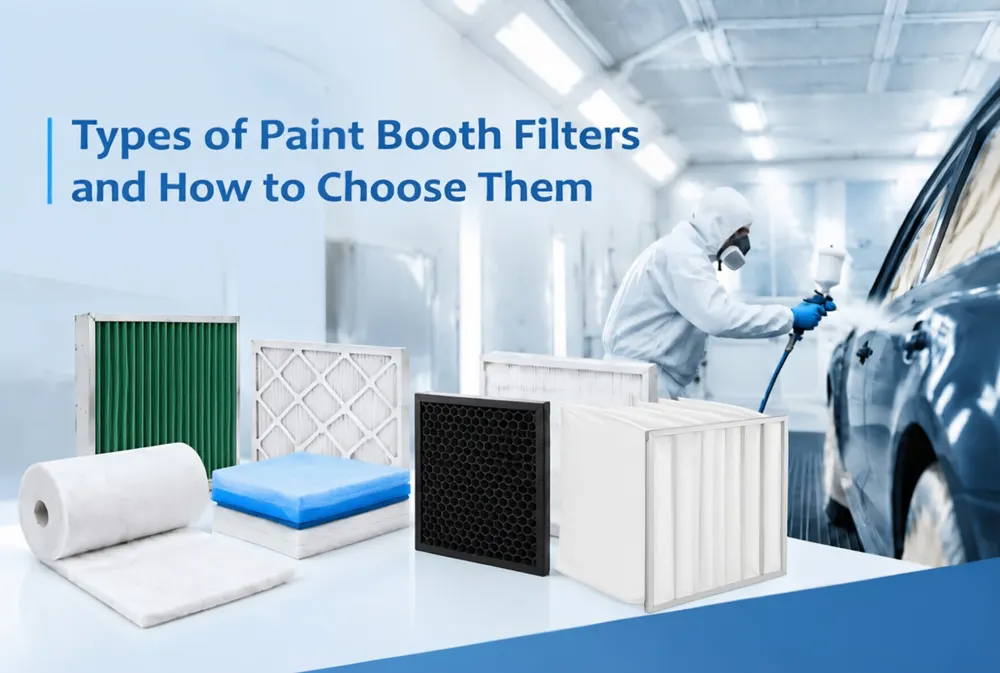
The difference between a smooth, defect-free finish and a costly rework job often comes down to filtration. Your paint booth filters control dust, overspray, airflow balance, exhaust emissions, and even VOC exposure, yet many buyers select them based only on size or price.
This guide breaks down the main types of paint booth filters, explains where each one belongs in the airflow path, and helps you choose the right combination for your booth, coating process, and air quality requirements.
How a Paint Booth Filtration System Works?
A paint booth uses several filters in sequence because it must manage different contaminants at different points in the airflow. Incoming air first passes through intake or pre-filters to remove dust and fibers. It then moves through ceiling or supply-air filters, which deliver cleaner and more evenly distributed air into the spray zone.
As you spray, paint mist and overspray are captured by paint stop filters, floor filters, or exhaust filters. Finally, if your process produces solvent vapors, odors, or VOCs, an activated carbon filter may be installed as a final gas-phase treatment stage. In short, the system works like this: intake filtration → supply-air filtration → overspray capture → exhaust filtration → optional VOC/odor control.
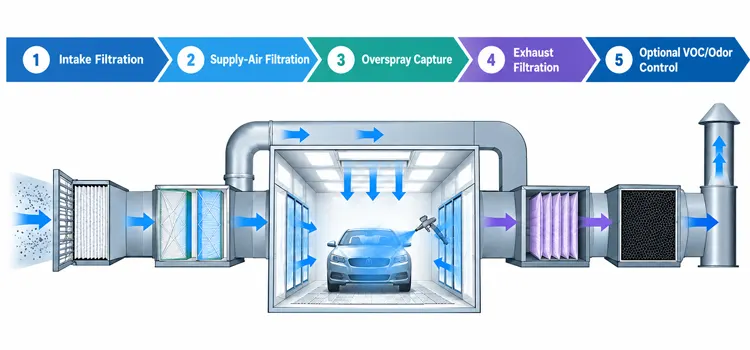
The exact arrangement depends on whether your booth is crossdraft, semi-downdraft, side-downdraft, or full downdraft. In a crossdraft booth, air generally enters at one end and exits through rear-wall filters; in a full downdraft booth, filtered air enters through the ceiling and exits through floor grilles and an exhaust pit.
Main Types of Paint Booth Filters
Intake Filters and Pre-Filters
Intake filters, often called pre-filters, are the first line of defense for your paint booth. They remove coarse contaminants from incoming air, such as dust, fibers, insects, pollen, and debris, before that air reaches the more sensitive ceiling or supply-air filtration stage.
Common intake filter options include polyester media pads, fiberglass rolls, pleated panel filters, and washable metal filters. Many booths use tackified synthetic media because its slightly sticky surface holds lightweight particles instead of letting them re-enter the airstream. Intake pre-filters are commonly specified in the MERV 7-11 range, depending on the booth design and local air quality.
For your operation, the key benefit is protection. A good pre-filter reduces the contaminant load on ceiling filters, helps stabilize airflow, and can extend the service life of more expensive downstream filters. If your facility is near a road, construction site, or dusty industrial area, upgrading the intake stage is often one of the most cost-effective improvements you can make.
Ceiling Filters and Supply-Air Filters
Ceiling filters, also called supply-air filters or diffusion media, are installed in the ceiling plenum or air-make-up unit of the booth. They deliver clean, evenly distributed air across the spray zone so dust and fibers don’t settle into wet paint.
These filters are especially important in downdraft and semi-downdraft booths, where the ceiling is a major part of the airflow path. Polyester ceiling media, fiberglass diffusion pads, and high-efficiency synthetic media are common choices. In many downdraft booths, ceiling diffusion media is specified at MERV 10 or higher.
When selecting ceiling filters, look beyond efficiency alone. You also need consistent media density, low and stable pressure drop, and sufficient dust-holding capacity. If the media loads unevenly or becomes too restrictive, it can disturb the airflow pattern across the workpiece and contribute to finish defects. For high-end automotive refinishing, furniture coating, or precision industrial finishing, ceiling filtration should be treated as a quality-control component, not just a consumable.
Paint Stop Filters and Paint Arrestors
Paint stop filters, also known as paint arrestors or overspray filters, capture wet paint particles produced during spraying. They are usually installed at the exhaust wall, exhaust pit, or beneath the floor grilles, depending on the booth design.
The most common options include:
- Fiberglass paint arrestor pads: Economical, widely used, and effective for capturing wet overspray.
- Polyester paint-stop media: Often selected for higher durability and heavier production environments.
- Baffle or labyrinth filters: Multi-layer kraft-paper or cardboard filters that force air to change direction, capturing overspray through impaction.
- Floor filters: Used in downdraft booths to collect overspray that settles toward the exhaust pit.
Paint arrestors protect more than the finish. They prevent sticky paint residue from accumulating in ductwork, fans, dampers, and exhaust stacks. The U.S. EPA identifies exhaust filters or paint overspray arrestors as a key method for capturing oversprayed coating mist before air leaves the booth.
If you spray high-volume, high-solids, or fast-drying coatings, overspray loading can rise quickly. In that case, a higher-capacity paint arrestor may reduce changeouts and help maintain steadier booth airflow.
Exhaust Filters
Exhaust filters are positioned in the exhaust path to capture fine particles and residual mist before air is discharged. While paint arrestors focus heavily on wet overspray, exhaust filters may provide additional filtration for finer aerosols and help protect downstream equipment.
Typical exhaust filter formats include fiberglass pads, polyester pads, pleated panel filters, bag filters, and high-efficiency final filters. The right choice depends on the coating type, exhaust volume, allowable pressure drop, and whether your process requires additional fine-particle control. For applications that demand cleaner exhaust air, high-efficiency media in the MERV 13-16 range is often considered for fine aerosol capture.telectronichub+1
When choosing exhaust filters, balance three factors: capture efficiency, initial resistance, and dust-holding capacity. A filter that is too efficient for your system may increase static pressure and reduce airflow; a filter that is too open may allow more contamination through. Your booth manufacturer’s specified pressure-drop range should always guide the final selection.
Activated Carbon Filters for VOCs and Odors
Activated carbon filters address a different problem from particulate filtration: gaseous contaminants. They adsorb VOCs, solvent vapors, and odor-causing compounds produced by solvent-based coatings, lacquers, and certain industrial finishing processes.
Carbon filters should normally be installed after particulate and overspray filtration. If wet paint mist reaches the carbon media first, it can coat the activated carbon and sharply reduce its adsorption capacity. For facilities that need odor control or VOC reduction, carbon panel filters, roll media, or cartridge systems can provide an effective final stage, but only when properly protected by upstream mechanical filtration.
Other Specialty Paint Booth Filters
Depending on your booth and coating process, you may also need specialty filters. Floor filters and grid filters capture overspray in downdraft systems. Bag filters offer higher dust-holding capacity for certain exhaust applications. HEPA or high-efficiency filters may be used where extremely clean air is required, such as precision coating, automotive refinishing, or sensitive industrial finishing. Washable metal filters can serve as durable pre-filters in environments with heavy debris.
These filters should complement, not replace, your core filtration stages. For example, a washable metal pre-filter can protect intake media, but it should not be used as the main paint arrestor because wet overspray requires disposable media designed for high liquid loading and safe disposal.
How to Choose the Right Paint Booth Filter?
Start with your booth type and airflow design. A crossdraft booth, semi-downdraft booth, and full downdraft booth place filters in different locations and expose them to different contaminant loads. Then consider the coating you spray: waterborne coatings, solvent-based coatings, high-solids paints, powder coatings, and UV-curable materials each create different filtration demands.
Use this quick selection guide:
| Your requirement | Recommended filter type |
|---|---|
| Protect incoming air from dust and debris | Intake pre-filter or roll filter |
| Provide clean, uniform air in the spray zone | Ceiling or supply-air filter |
| Capture wet paint overspray | Paint stop filter or paint arrestor |
| Protect exhaust fans and ductwork | Exhaust panel, pad, or bag filter |
| Reduce VOCs, solvent vapor, and odor | Activated carbon filter |
| Achieve very high air cleanliness | HEPA or high-efficiency final filter |
You should also verify the filter dimensions, frame style, airflow direction, media orientation, and maximum pressure drop before ordering. A filter may look similar but perform poorly if it does not match the booth’s face velocity, sealing arrangement, or filtration stage.
Spray Booth Filter Replacement and Maintenance
Do not rely only on a fixed calendar schedule. Filter loading changes with production volume, paint type, booth utilization, and ambient conditions. The most reliable approach is to track pressure drop across each filter stage and replace filters when they reach the manufacturer’s recommended final resistance.
As a practical maintenance routine, record the clean pressure drop when new filters are installed, inspect filters during scheduled maintenance, and monitor for warning signs such as reduced airflow, visible overspray bleed-through, excessive pressure drop, or paint buildup on fan components. Ceiling filters are often changed at least twice a year in many operations, but your actual interval should be based on measured conditions and booth manufacturer guidance.
For activated carbon filters, replacement is not always visible. Track operating hours, solvent usage, odor complaints, and VOC concentration where monitoring is available. Once the carbon media approaches saturation, its adsorption performance declines even if the filter still looks clean.
Conclusion
The best paint booth filtration system is not a single filter; it is about building a filtration system that matches your booth design, coating process, airflow requirements, and emission-control needs. Intake filters protect the system, ceiling filters protect the finish, paint arrestors capture overspray, exhaust filters protect equipment and emissions, and activated carbon filters handle VOCs and odors.
If you are selecting replacement filters or designing a new spray booth, review the filter location, dimensions, pressure-drop limits, coating type, and VOC control requirements before purchasing. If you are unsure which filter configuration suits your spray booth, please contact CENCARB filtration specialist who can match the media to your actual operating conditions.