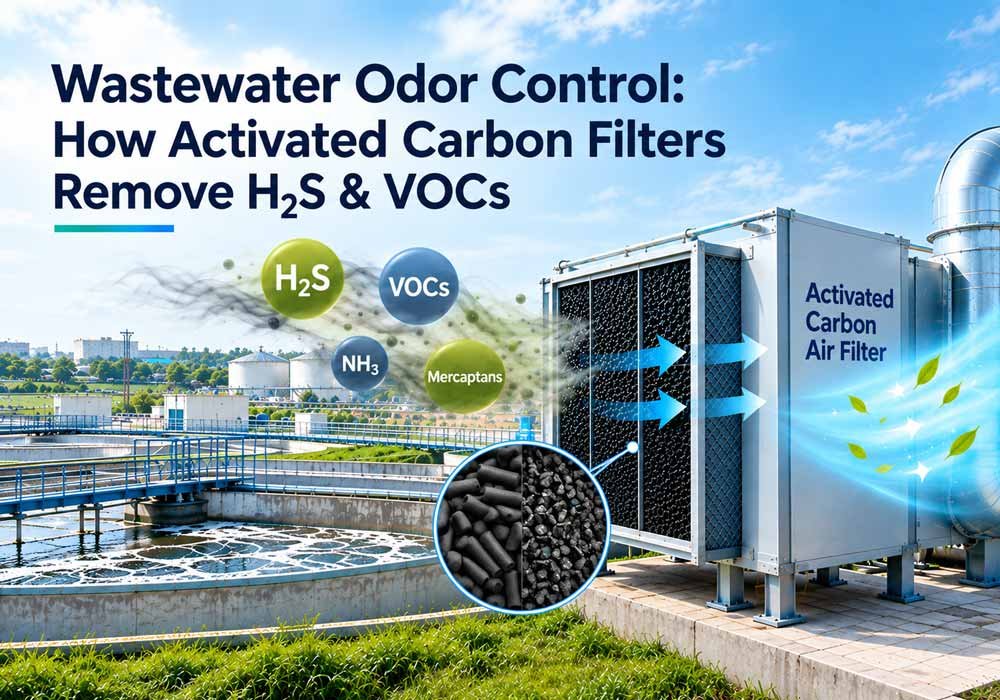
Odor is often the first sign that a wastewater air-treatment system needs attention, but it is rarely “just a smell.” Hydrogen sulfide can accelerate corrosion, volatile organic compounds (VOCs) can create persistent odor complaints, and mixed gas streams can make a simple filtration decision surprisingly complex. For wastewater facilities, lift stations, and industrial treatment operations, activated carbon air filters offer a compact solution for capturing odor-causing gases before they leave the site.
This guide explains what causes wastewater odors, how activated carbon filtration works, when it is the right choice, and what you should evaluate before selecting an odor control filter.
What Causes Odor in Wastewater Treatment Plants?
Wastewater odors are primarily produced when biodegradable organic material breaks down under low-oxygen or anaerobic conditions. As wastewater passes through sewers, lift stations, equalization tanks, headworks, primary treatment areas, sludge tanks, and digesters, microorganisms generate gases that can become noticeable even at very low concentrations.
Hydrogen sulfide is commonly associated with the characteristic “rotten egg” odor. It is especially likely to form where wastewater is warm, stagnant, highly loaded, or retained for a long period, such as in force mains and enclosed treatment areas. In addition to odor complaints, H₂S can contribute to corrosion of concrete, metal structures, ductwork, and electrical equipment.
For many facilities, odor becomes a bigger issue when process air is released from enclosed sources. Ventilation systems can collect this foul air and route it to an odor control unit, allowing you to treat the gas stream before it is discharged through a stack or outlet.
Main Odorous Gases in Wastewater
Wastewater odor control requires more than measuring H₂S alone. A typical foul-air stream may contain sulfur compounds, nitrogen compounds, and organic gases; each behaves differently and may require a different type of activated carbon media.
| Gas or compound | Typical odor character | Common wastewater sources | Filtration consideration |
|---|---|---|---|
| Hydrogen sulfide (H₂S) | Rotten egg | Lift stations, headworks, sewers, sludge handling | Usually requires impregnated or catalytic activated carbon for reliable removal. |
| VOCs | Chemical, solvent-like, sweet, or musty | Industrial influent, equalization tanks, process enclosures | Often removed by adsorption on virgin or specialty activated carbon. |
| Ammonia (NH₃) | Sharp and pungent | Sludge processing, dewatering, biosolids areas | May require acid-treated or blended media rather than standard carbon. |
| Mercaptans and reduced sulfur compounds | Cabbage-like, sulfurous, or skunk-like | Sludge areas, anaerobic zones, industrial wastewater | Often requires impregnated carbon or a layered-media configuration. |
In real-world wastewater applications, the odor profile is often mixed. Your system may need to remove H₂S at the source while also controlling VOCs, mercaptans, and residual organic odors. That is why a site-specific air analysis is more reliable than selecting an activated carbon filter based only on airflow or a general odor description.
What is an Activated Carbon Air Filter?
An activated carbon air filter is a gas-phase filtration device designed to remove gaseous contaminants rather than dust particles. Its carbon media contains a highly porous internal structure with a large surface area, allowing odor molecules and chemical vapors to be captured as air passes through the filter bed.
For VOCs and many organic odor compounds, removal occurs primarily through physical adsorption. Gas molecules are drawn into the carbon pores and held on the internal surface. For wastewater odor control, this approach is particularly useful for treating low-concentration VOCs and for polishing residual odors after another treatment stage.
H₂S requires more careful media selection. Standard activated carbon may provide limited H₂S capacity, while impregnated carbon is engineered to react with sulfur gases and improve removal performance. Alkaline-impregnated media are commonly used for sulfide-dominated wastewater odor streams, whereas blended media may be a better option when H₂S, VOCs, ammonia, and mercaptans occur together.
How Do Activated Carbon Filters Control Wastewater Odors?
Activated carbon filters control wastewater odors through a combination of adsorption and chemical reaction. The incoming foul air is collected through ductwork and passed through a carbon bed. As the gas contacts the media, compounds such as VOCs, mercaptans, and organic odor molecules are adsorbed within the carbon’s pore network.
For H₂S removal, impregnated activated carbon can provide chemisorption in addition to adsorption. The carbon is treated with an active chemical compound that reacts with hydrogen sulfide, converting it into less volatile and more stable by-products retained in the media. This is why carbon type matters as much as carbon quantity.
Performance depends on the full design of the odor control system, not simply on installing more carbon. Key factors include airflow, inlet gas concentration, gas temperature, humidity, bed depth, empty-bed contact time, pressure drop, and whether the air stream contains dust, moisture, or oil aerosols. For complex municipal odor blends, longer contact time and layered media may be necessary to maintain practical media life and reliable odor reduction.
Types of Activated Carbon Filters for Wastewater Odor Control
Activated carbon filters are available in different media forms and housing designs. The right configuration depends on your airflow, odor loading, gas composition, available footprint, maintenance requirements, and desired media-change interval.
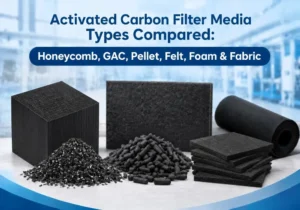
Honeycomb Activated Carbon Filters
Honeycomb activated carbon filters use a structured panel or block with many small air channels. Their low pressure drop makes them useful in compact ventilation systems, terminal filters, or odor-polishing applications where fan capacity is limited.
However, honeycomb filters typically contain less carbon mass than deep-bed systems. They are better suited to lower contaminant loads, intermittent odors, or final-stage treatment rather than heavy continuous H₂S duty.
Granular Activated Carbon Filters
Granular activated carbon, often called GAC, consists of irregular carbon granules placed in trays, cassettes, or deep-bed vessels. It provides high surface area and is commonly used for VOC adsorption, mixed organic odors, and general odor polishing.
For wastewater odor control, granular carbon can be selected as virgin carbon, catalytic carbon, or chemically impregnated carbon. The housing should distribute airflow evenly across the bed; otherwise, channeling can reduce contact time and cause early odor breakthrough.
Pelletized Activated Carbon Filters
Pelletized activated carbon is manufactured as uniform cylindrical pellets. It has consistent particle size, good mechanical strength, and predictable airflow resistance, making it a practical choice for industrial odor control vessels and replaceable carbon canisters.
For wastewater applications dominated by hydrogen sulfide, KOH or NaOH-impregnated pelletized carbon is often used because it provides targeted H₂S removal and performs well in engineered deep-bed systems.
Impregnated Activated Carbon Filters
Impregnated activated carbon is treated with reactive chemicals to improve removal of specific gases. Alkaline formulations are commonly used for H₂S, while other media formulations may target ammonia, acid gases, mercury, or a wider mixture of contaminants.
If you are controlling a mixed odor stream, a single media type may not be enough. A layered carbon bed can combine an H₂S-focused media with virgin carbon or a polishing media for VOCs and residual sulfur compounds. This approach can improve overall odor removal and help use each type of media more efficiently.
Activated Carbon Filter vs Biofilter vs Chemical Scrubber
Activated carbon filters, biofilters, and chemical scrubbers are established wastewater odor control technologies. Rather than asking which system is universally “best,” compare them against your gas concentration, airflow, available space, utility requirements, maintenance capability, and target removal efficiency.
| Technology | Best suited for | Advantages | Considerations |
|---|---|---|---|
| Activated carbon filter | Low-to-medium H₂S concentrations, VOCs, mixed odors, and final polishing | Compact footprint, quick installation, broad gas-phase treatment capability, no continuous liquid recirculation | Media must be replaced or regenerated; operating cost can rise rapidly for high or variable H₂S loads. |
| Biofilter / biotrickling filter | Dilute, steady, biodegradable odor streams | Lower chemical use and low operating cost for stable, continuous applications | Requires more footprint and close control of moisture, nutrients, temperature, and biological conditions. |
| Chemical scrubber | High H₂S or ammonia concentrations, demanding removal targets, and high airflow | High removal capability and effective treatment for severe odor loads | Requires chemical storage, dosing, recirculation, wastewater management, and skilled operation. |
A hybrid system is often the strongest engineering solution. For example, a biofilter or chemical scrubber can handle the bulk contaminant load, while an activated carbon filter acts as a polishing stage to manage residual odor, VOCs, and short-term variations in process conditions.
How to Select an Activated Carbon Odor Control Filter?
Before purchasing an activated carbon odor control filter, define your operating conditions clearly. The most common selection mistake is choosing equipment based only on airflow or price, without confirming the contaminant profile and required removal performance.
Start by collecting the following information:
- Airflow rate, usually expressed in CFM or m³/h.
- H₂S inlet concentration and target outlet concentration.
- VOC types and estimated concentrations, if available.
- Temperature, humidity, and particulate loading in the air stream.
- Available installation space and duct connection size.
- Required pressure drop and fan capacity.
- Expected media replacement interval and maintenance access.
- Local odor, safety, and emission requirements.
For H₂S control, ask whether the proposed media is standard activated carbon, catalytic carbon, or alkaline-impregnated carbon. Standard carbon may be acceptable for very low H₂S concentrations, while impregnated or catalytic carbon is generally more appropriate for higher H₂S loads.
Also consider whether the system needs pre-filtration. Dust, moisture, oils, and aerosols can reduce carbon performance, so a particulate pre-filter may be necessary in dusty or humid environments. A well-designed activated carbon system should balance removal efficiency, pressure drop, media life, and ease of maintenance.
Conclusion
Wastewater odor control is most effective when it starts with an accurate understanding of the gas stream. H₂S may be the main concern, but VOCs, ammonia, mercaptans, humidity, airflow changes, and peak loading can all influence which odor control technology will perform reliably.
Activated carbon air filters are a practical option for low-to-medium contaminant loads, mixed odors, and final polishing after biological or chemical treatment. By selecting the right carbon media-particularly impregnated or blended media for H₂S and multi-gas applications, you can reduce odor complaints, protect equipment from corrosive gases, and improve conditions for workers and nearby communities.