When a cleanroom, operating room, or semiconductor line depends on stable air quality, the most important filter is often the one installed last. A terminal HEPA filter is the final barrier before filtered air enters a controlled environment – where even a small bypass leak or incorrect selection can affect product quality, safety, and compliance.
This guide explains what terminal HEPA filters are, how they capture airborne particles, which types are available, where they are used, and how to choose, install, and maintain them for reliable clean-air performance.
What is a Terminal HEPA Filter?
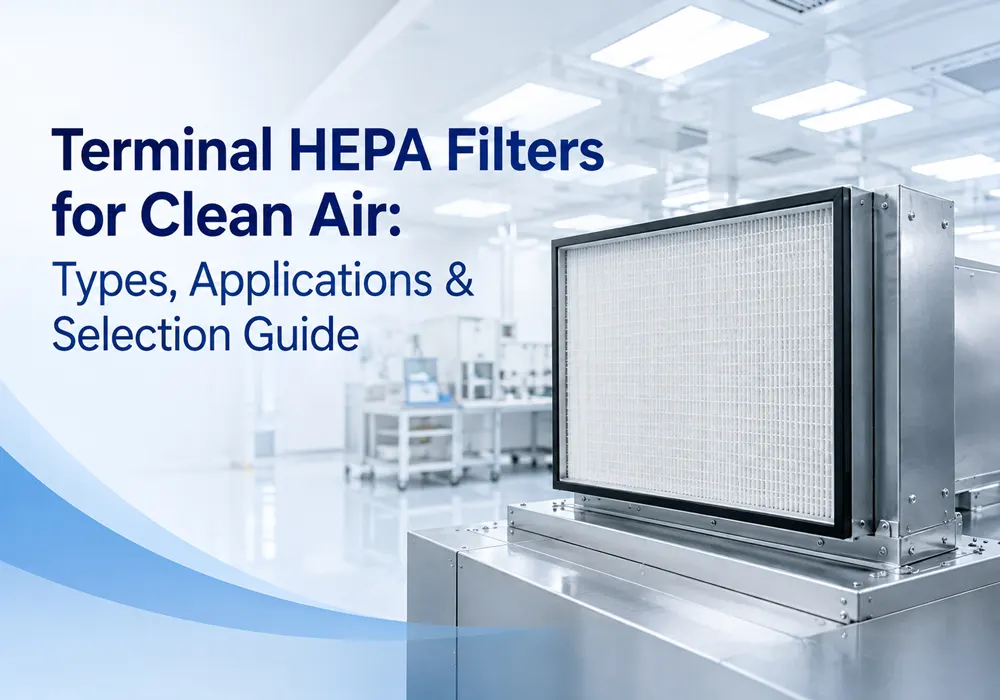
A terminal HEPA filter is a high-efficiency particulate air filter installed at the end of a supply-air system. It is commonly fitted inside a terminal housing, HEPA terminal box, ceiling diffuser, laminar-flow module, or fan filter unit (FFU).
The term “terminal” refers to its position in the airflow path. Unlike a HEPA filter installed inside an air-handling unit or duct, a terminal HEPA filter is the last filter through which air passes before it enters a cleanroom, laboratory, operating room, or other controlled space.
Its role is to deliver filtered air directly to the point of use while helping maintain the required cleanliness level, airflow pattern, and pressure relationship within the room. For this reason, a terminal HEPA filter should be evaluated as part of the complete air-delivery system, not as an isolated component.
How Do Terminal HEPA Filters Work?
Terminal HEPA filters use densely packed glass-fiber or synthetic media to capture airborne particles. The media does not work like a simple mesh screen. Instead, it captures particles through several mechanisms that operate simultaneously.
Filtration Mechanisms
- Interception: Particles traveling in the airstream come close to a filter fiber and adhere to it.
- Impaction: Larger particles cannot follow the curved airflow around fibers because of their momentum, so they collide with and stick to the media.
- Diffusion: Very small particles move irregularly due to Brownian motion, increasing the chance that they will contact and be captured by filter fibers.
Together, these mechanisms allow HEPA filtration to capture particles across a broad size range. Actual performance depends on the filter class, test standard, particle size, airflow rate, and installation quality.
Why the Final Filter Position Matters?
In a properly designed system, pre-filters remove the majority of larger dust before air reaches the terminal HEPA stage. This reduces the particle load on the final filter and helps slow the rise in pressure drop.
The terminal position is important because it limits the opportunity for air to become contaminated after final filtration. However, the filter media alone cannot guarantee performance. The housing, sealing method, installation workmanship, and post-installation leak testing all determine whether the clean air actually reaches the room without bypass leakage.
Terminal HEPA Filters vs Standard HEPA Filters
“Terminal HEPA filter” and “standard HEPA filter” are related but not identical terms. A terminal HEPA filter is a HEPA filter installed at the final point of air delivery, while a standard HEPA filter may be installed anywhere in an HVAC or process-air system.
| Feature | Terminal HEPA Filter | Standard HEPA Filter |
|---|---|---|
| Installation location | At the end of the supply-air system, in a terminal housing, HEPA box, diffuser, or FFU | AHU, ductwork, equipment enclosure, or other system location |
| Primary role | Final-stage filtration immediately before air enters a controlled space | High-efficiency filtration within a larger HVAC or process-air system |
| Critical design factors | Sealing, face velocity, pressure drop, leak testing, and ease of replacement | Filtration efficiency, rated airflow, resistance, and dust-holding capacity |
| Typical environments | Cleanrooms, operating rooms, laboratories, electronics manufacturing | Commercial HVAC, industrial ventilation, equipment filtration |
| Common accessories | Pressure gauge, terminal housing, diffuser plate, gel seal or gasket frame | Pre-filters, fan sections, dampers, and ductwork |
Common Types of Terminal HEPA Filters
Terminal HEPA filters can be classified in several ways, including sealing method, filter-media construction, housing design, and airflow configuration. These categories overlap: for example, a mini-pleat filter may use either a gel seal or a gasket seal. Selecting the right combination is more useful than treating all types as mutually exclusive alternatives.
Gel-Seal Terminal HEPA Filters
Gel-seal terminal HEPA filters use a gel-filled channel or knife-edge interface to create a seal between the filter and its matching housing. When installed correctly, the interface helps prevent unfiltered air from bypassing the filter. Gel-seal designs are frequently considered for cleanrooms and other environments where reliable sealing and installation integrity are especially important.
Compatibility between the gel channel and the housing knife edge is essential. Buyers should confirm the specified seal geometry, housing design, installation procedure, and replacement method before ordering. Improper handling or an incompatible housing can damage the sealing interface and compromise system performance.
Gasket-Seal Terminal HEPA Filters
Gasket-seal terminal HEPA filters use a compressible gasket, commonly made from a suitable elastomer or other sealing material, to form an airtight interface with the housing or mounting frame. They are widely used in terminal filtration systems because the design is familiar and can be practical for inspection and replacement when the unit is designed for service access.
The gasket must be compatible with the operating temperature, humidity, cleaning agents, and other environmental conditions. Even a high-efficiency filter may perform poorly in service if the gasket is damaged, compressed unevenly, or incorrectly positioned. During installation, the mounting frame and clamping system should apply the required, even compression without deforming the filter.
Mini-Pleat Terminal HEPA Filters
Mini-pleat HEPA filters use closely spaced pleats to increase the effective media area within a relatively shallow filter pack. Depending on the design, this can help achieve the required airflow and filtration efficiency while managing pressure drop and the overall dimensions of the terminal unit.
Mini-pleat construction is common in compact terminal systems, including ceiling-mounted installations. However, pressure drop and service life depend on more than pleat spacing alone. Media characteristics, filter dimensions, airflow, upstream particle loading, and the quality of the filter assembly all influence performance.
Terminal HEPA Filter Units with Integrated Diffusers
Some terminal HEPA products combine the filter and housing with an air diffuser or distribution component. The integrated design can simplify coordination between filtration and room air distribution, particularly in ceiling installations where space is limited and a controlled supply-air pattern is required.
These units should be selected according to the room’s airflow strategy, ceiling configuration, required air volume, and maintenance access. A diffuser does not automatically guarantee uniform airflow throughout the room; the final distribution pattern depends on the complete HVAC design, supply-air conditions, room geometry, and interaction with return-air locations and internal heat loads.
H13 and H14 Terminal HEPA Filters
H13 and H14 are common HEPA filter classifications under the EN 1822 framework. Under the standard’s test conditions at the most penetrating particle size (MPPS), H13 filters have an overall efficiency of at least 99.95%, while H14 filters have an overall efficiency of at least 99.995%. The corresponding maximum local penetration limits are 0.25% for H13 and 0.025% for H14.
H14 is not automatically the better choice for every application. A higher-efficiency grade may increase cost or pressure drop depending on the product design, and it must still be compatible with the system’s airflow requirements. Select the class based on the required cleanliness level, risk assessment, applicable standards, and project specifications. Always verify the classification and test report for the exact product being purchased.
Where Are Terminal HEPA Filters Used?
Terminal HEPA filters are used wherever airborne particles could affect product quality, process reliability, occupant safety, or regulatory compliance.
Pharmaceutical and Biotechnology Cleanrooms
Pharmaceutical and biotechnology facilities use terminal HEPA filters in cleanrooms, filling lines, sampling areas, and quality-control zones. They support contamination control in environments where product sterility, batch consistency, and regulatory compliance are essential.
In these facilities, terminal filtration works alongside pressure cascades, air-change rates, environmental monitoring, gowning procedures, and cleaning protocols.
Hospitals and Healthcare Facilities
Terminal HEPA filters may be used in operating rooms, protective environments, isolation-related applications, and other healthcare spaces where enhanced particle control is required by the design or applicable guidance. The correct solution depends on the intended clinical function, ventilation design, and relevant healthcare standards.
Not every hospital room requires terminal HEPA filtration. The filter should be specified according to the actual risk and performance requirements rather than applied uniformly across all areas.
Laboratories and Research Facilities
Research laboratories, testing facilities, and specialized work areas may use terminal HEPA filters to control airborne particles that could affect experiments, samples, instruments, or sensitive procedures. In laboratories handling hazardous biological or chemical materials, HEPA filtration must be considered as part of the appropriate containment and exhaust strategy; it does not replace the need for suitable biosafety cabinets, fume hoods, or other protective equipment.
Semiconductor and Electronics Manufacturing
Semiconductor, precision electronics, and optical manufacturing processes can be sensitive to particle contamination. Terminal HEPA or, where necessary, ULPA filtration may be used in cleanroom supply systems to help maintain the required airborne cleanliness. Filter selection should account for the target particle-control level, airflow uniformity, equipment layout, operating stability, and the facility’s contamination-control plan.
Food, Cosmetic, and Controlled Production Areas
Food, beverage, cosmetic, and personal-care facilities may use terminal HEPA filtration in filling, packaging, weighing, and inspection areas. The objective is to reduce airborne dust and support hygienic production processes.
The appropriate solution depends on the product, applicable quality standards, room classification, and the contamination risks identified in the facility’s quality system.
Key Factors to Consider When Selecting a Terminal HEPA Filter
The right terminal HEPA filter is not always the one with the highest efficiency rating. It is the one that fits your airflow, cleanliness target, installation space, and operating budget.
Before ordering, confirm these points with your engineering team or filtration supplier:
- Filter class: Choose H13, H14, or ULPA based on your cleanliness requirement, not simply the highest available class.
- Airflow and pressure drop: Make sure the filter can deliver the required air volume without excessive resistance.
- Size and frame: Check dimensions, frame material, and compatibility with the terminal housing or FFU.
- Sealing method: Gasket seals suit many applications, while gel seals are often used where leakage control is critical.
- Test documentation: Ask for efficiency, pressure-drop, airflow, and leak-test data before purchase.
A filter that matches the complete system will usually perform better and cost less to operate than one selected on efficiency alone.
Installation Best Practices for Reliable Clean Air
Even a high-quality terminal HEPA filter will not perform well if it is installed poorly. Sealing and handling matter as much as filter efficiency.
Before installation, check the filter and housing for damage. Confirm the model, size, airflow direction, and sealing method match the project specification.
During installation, handle the filter by the frame and follow the manufacturer’s instructions for gasket compression and fastening. Do not force a filter into a misaligned housing, as this can damage the seal and allow unfiltered air to bypass the media.
After installation, verify airflow, record the initial pressure drop, and carry out leak testing where required. Keep the installation and test records for future maintenance and validation.
How to Maintain Terminal HEPA Filters
Terminal HEPA filters are generally replaced rather than cleaned. How long they last depends on upstream filtration, dust load, operating hours, and the pressure drop your system can accept.
Monitor pressure drop from the day of installation. A gradual increase is normal, but a rapid rise may indicate heavy dust loading, an airflow problem, or an issue with upstream filters.
Replace the filter when pressure drop, airflow, or cleanliness monitoring shows that performance is no longer acceptable. Avoid relying only on a fixed time schedule, because real service life varies from one facility to another.
When replacing the filter, isolate the airflow, remove it carefully, and dispose of it according to site procedures. Record the new filter details and update your maintenance log.
Conclusion
A terminal HEPA filter is the final barrier that protects your cleanroom, laboratory, or production area from airborne contamination. To get dependable results, match the filter to your system, install it with proper sealing, and maintain it based on actual performance data.
If you need help choosing the right terminal HEPA filter, review your airflow and cleanliness requirements first, then consult Cencarb air filtration specialist for the most suitable specification.