When your process requires clean air at 250°C, 350°C or higher, choosing a HEPA filter becomes an engineering decision, not a simple catalog selection. Heat affects filter media, frames, sealants, gaskets and ductwork differently. A filter that looks suitable on paper may develop bypass leakage, seal cracking or structural deformation after repeated thermal cycles.
This guide explains how high-temperature HEPA filters work, what “350°C HEPA filter” really means, and how to select, install and validate a filter for your application. Whether you are specifying filtration for a pharmaceutical depyrogenation tunnel, an electronics curing oven, an automotive paint booth or an industrial dryer, you will find a practical framework for making a reliable choice.
What is a High-Temperature HEPA Filter?
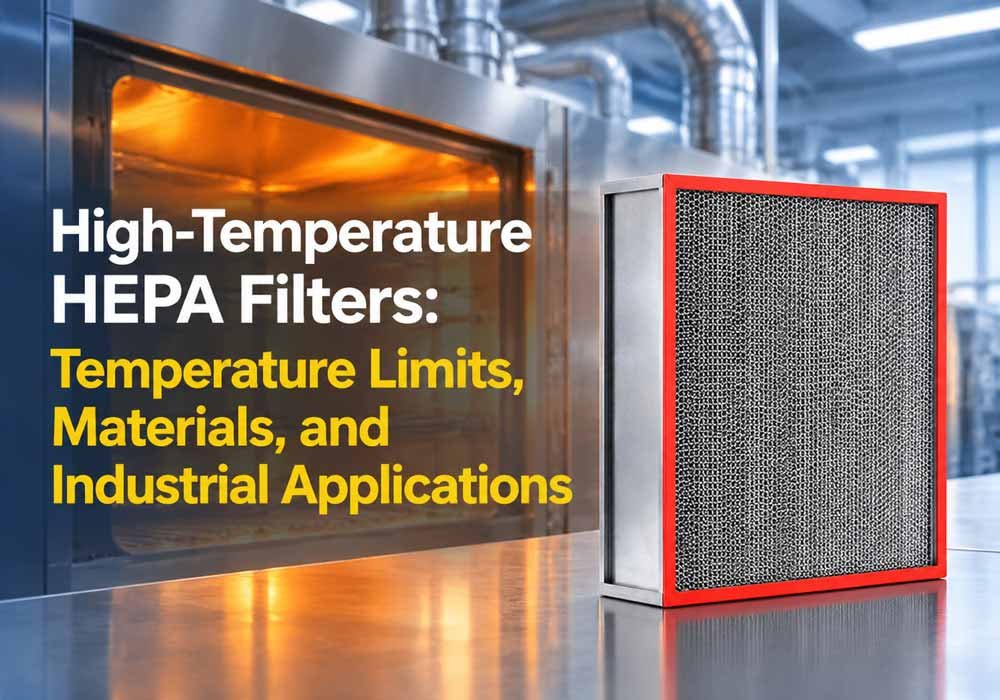
A high-temperature HEPA filter is an air filter that maintains HEPA-level particle capture efficiency while preserving structural integrity, sealing performance, and low leakage under sustained high temperatures.
“High-temperature HEPA” is not one single product category. It is a solution defined by the combination of operating temperature, filter media, frame, separators, sealant, and gasket.
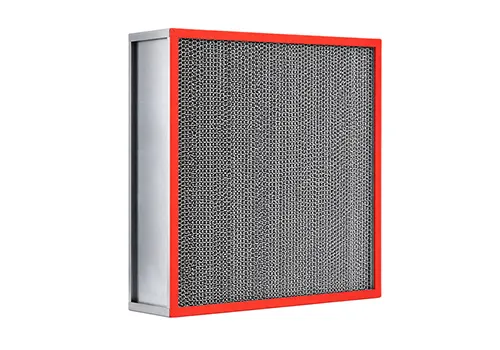
| Item | Standard HEPA Filter | High-Temperature HEPA Filter |
|---|---|---|
| Typical continuous temperature | Usually suitable for conventional HVAC and cleanroom environments | Usually starts above approximately 120°C; common designs cover 250–350°C, while some custom solutions address higher short-term peaks |
| Media | Conventional glass fiber or composite media | Heat-resistant glass fiber or borosilicate glass-fiber media |
| Frame | Aluminum, galvanized steel, plastic and similar materials | Stainless steel, with special heat-resistant structures where required |
| Separators | Hot-melt threads, aluminum foil and similar materials | Aluminum foil, stainless steel or ceramic separators |
| Sealing | Conventional polyurethane, silicone and similar materials | High-temperature silicone, ceramic-based sealants, glass-fiber rope gaskets and similar materials |
| Main risks | Efficiency and pressure drop | Seal aging, thermal deformation, bypass leakage and media damage |
A HEPA grade describes filtration efficiency. It does not automatically define temperature resistance. When purchasing, you must specify both the efficiency class and the complete temperature boundary of the application.
H13 vs. H14 High-Temp HEPA Filters: How to Choose the Efficiency Class?
EN 1822 and ISO 29463 evaluate high-efficiency filters at the most penetrating particle size, or MPPS. This approach provides a more meaningful assessment of real filtration performance than a single particle-size efficiency value.
For HEPA filters, the most common classes are:
- H13: Typically provides at least 99.95% overall efficiency at MPPS.
- H14: Typically provides at least 99.995% overall efficiency at MPPS.
When to Choose H13 Filters?
H13 is suitable for many industrial ovens, curing systems, drying equipment and general high-temperature clean-air supply applications. It provides strong particle control while usually offering a more balanced pressure drop and operating cost.
When to Choose H14 Filters?
H14 is appropriate for pharmaceutical depyrogenation, hot air associated with aseptic filling, highly sensitive electronics processes or applications where regulations and customer specifications require a higher level of assurance.
For a closer comparison of efficiency, pressure drop, and selection criteria, see our guide to H13 vs. H14 HEPA filters.
When to Consider ULPA or U15 Filters and Above?
ULPA filters, including U15 and higher classes, should only be considered when process risk, cleanliness requirements and system pressure-drop capacity all support the selection.
Do not treat ULPA as automatically “safer.” A higher efficiency class can increase pressure drop, energy consumption and operating cost if the process does not require it.
High temperature changes air density, viscosity and system resistance. Do not apply room-temperature airflow or pressure-drop data directly to a high-temperature system.
How to Understand Temperature Limits: Continuous, Peak and Thermal Cycling?
Many buyers search for a “350°C high-temperature HEPA filter,” but temperature alone does not determine suitability. Two filters may both be marketed for 350°C, yet perform very differently in a real process.
Before selecting a filter, separate these temperature conditions:
- Continuous operating temperature: The temperature the filter sees during normal, sustained operation.
- Peak temperature: The highest short-term temperature reached during sterilization, curing, drying or a process upset.
- Ramp rate: How quickly the system heats up and cools down.
- Thermal cycling frequency: How many heating and cooling cycles occur per day, batch or year.
- Dwell time: How long the filter remains at a given temperature.
For example, a filter exposed to 300°C for eight hours per day has a different duty cycle from one exposed to 350°C for ten minutes per batch. The second condition may have a higher peak temperature, but the first may create greater cumulative thermal aging.
You should also measure the temperature at the filter location, not only at the heater outlet. Duct geometry, insulation, airflow distribution and proximity to heating elements can create local hot spots.
What Determines High-Temperature HEPA Filters Performance?
A high-temperature HEPA filter is a system of materials and interfaces. Its real temperature limit is determined by the weakest component, not by the filter media alone.
Filter Media
Heat-resistant glass-fiber or borosilicate-glass media is commonly used because it maintains fine-fiber filtration performance at elevated temperatures. The media must remain stable after repeated thermal exposure and must be protected from mechanical damage during handling and installation.
Frame and Separators
Stainless-steel frames are widely used in high-temperature filters because they resist deformation better than many conventional frame materials. Aluminum foil, stainless steel or ceramic separators help maintain pleat spacing, support the media and promote even airflow.
Sealant
The sealant bonds the filter media to the frame and helps prevent bypass leakage. At high temperature, ordinary adhesives can harden, crack, shrink or lose adhesion. High-temperature silicone, ceramic-based sealants or other application-specific materials may be required.
Gaskets and Sealing Interface
Even a high-quality filter can leak if the gasket, mounting frame or clamping arrangement is inadequate. Heat-resistant silicone, ceramic fiber, glass-fiber rope and compatible sealing designs are selected according to temperature, compression, flange flatness and maintenance requirements.
Housing and Ductwork
The filter housing, access door, clamping mechanism and surrounding ductwork also expand and contract with heat. If the housing distorts, the filter may no longer seal correctly. A complete thermal assessment should include the installation environment, not only the filter element.
Common Failure Modes in Hot Air Systems
High-temperature HEPA filters rarely fail because the media suddenly stops filtering. More often, performance is compromised by bypass leakage or physical damage.
Common failure modes include:
- Sealant aging or cracking: Repeated heating and cooling can cause sealant to become brittle or separate from the frame.
- Thermal deformation: Frames, flanges and housings expand unevenly, creating gaps at the sealing interface.
- Thermal shock: Rapid temperature changes can stress different materials at different rates.
- Gasket compression loss: A gasket that is undersized, incorrectly compressed or incompatible with the temperature may leak.
- Media damage: Vibration, poor handling, excessive airflow or incorrect installation can damage pleats.
- Moisture and condensation: During shutdown or cooling, condensation may affect certain materials if the system is not properly managed.
- High particle loading: Insufficient pre-filtration increases pressure drop, energy consumption and replacement frequency.
If your system shows rising pressure drop, unstable airflow, visible seal damage or a failed downstream particle test, investigate the complete installation, not just the filter cartridge.
How to Select High-Temperature HEPA Filters?
Use the following sequence when specifying a filter. It prevents the most common selection error: choosing a filter based on one temperature value.
1. Define the Process Requirement
Start with the clean-air objective. Identify whether the application requires H13, H14 or another efficiency class, and determine whether the filter is protecting product quality, personnel, equipment or a regulated process.
2. Map the Full Temperature Profile
Record continuous temperature, peak temperature, ramp rate, dwell time, cycle frequency and shutdown conditions. A simple temperature-time profile is more useful than a single maximum-temperature claim.
3. Confirm Airflow and Pressure Drop
Provide the required airflow, allowable pressure drop, fan capacity and acceptable final pressure drop. Hot air has different density and viscosity from ambient air, so do not transfer room-temperature airflow data directly to a high-temperature system.
4. Select the Filter Class
Choose H13 for many industrial ovens, curing systems, drying equipment and general high-temperature clean-air supply. Choose H14 when process risk, regulatory requirements or customer specifications demand a higher level of assurance.
Do not automatically choose the highest efficiency class. A higher class may increase pressure drop, energy use and operating cost if the process does not require it.
5. Match Materials to the Application
Specify the frame material, separator type, sealant, gasket, flange design and any special requirements such as food-contact compatibility, corrosion resistance or custom dimensions.
6. Plan Pre-Filtration
A properly selected pre-filters protects the final HEPA filter from coarse dust, fibers and process contamination. This can extend service life, stabilize pressure drop and reduce total cost of ownership.
7. Agree on Acceptance Criteria
Define the factory tests, installation tests, leakage-scan method, pressure-drop limits and documentation you require before the system is released for production.
Where are High Temperature HEPA Filters Used?
High-temperature HEPA filters are used wherever clean air and elevated temperature occur in the same process.
| Application | Typical challenge | Selection focus |
|---|---|---|
| Pharmaceutical depyrogenation tunnels and dry-heat ovens | High temperature, repeated cycles, strict contamination control | H14, traceable testing, integrity testing and robust sealing |
| Electronics curing, drying and reflow processes | Particle-sensitive products and stable airflow | H13 or H14, low pressure drop, consistent airflow |
| Automotive paint booths and curing ovens | Surface defects caused by airborne particles | Pre-filtration plus heat-resistant final filtration |
| Food baking, drying and powder processing | Hygiene, heat and particulate control | Appropriate materials, cleanability and replacement access |
| Metal processing, welding and laser cutting | Sparks, oil mist and high particulate loading | Spark arrestors, fire protection and pre-filtration are essential |
| Laboratories and sterilization equipment | Limited space and cyclic heating | Custom sizes, serviceable design and verified sealing |
For welding, plasma cutting, laser cutting, or other spark-generating processes, a high-temperature HEPA filter must never be treated as a substitute for spark arrestors, fire dampers, or appropriate pre-filtration. The filter is the final clean-air stage, not a primary safety device.
How to Installation and Integrity Testing High Temperature HEPA Filters?
Installation quality has as much influence on performance as filter design. A correctly manufactured filter can still leak if it is installed with an uneven flange, damaged gasket or insufficient clamping force.
Before installation, inspect the filter for damaged pleats, frame deformation, loose separators, gasket defects and incorrect labeling. Confirm the airflow direction, filter dimensions, sealing surface condition and available maintenance access.
After installation, perform:
- A downstream leakage scan using PAO, DOP or an approved equivalent method.
- Airflow and face-velocity verification.
- Initial pressure-drop measurement.
- Cleanliness or particle-count verification where required by the process.
- A repeat integrity test after the first high-temperature cycle, especially for critical applications.
For pharmaceutical systems, filters serving as sterile boundaries, including filters in dry-heat depyrogenation tunnels and ovens, should be integrity tested upon installation and periodically thereafter. Testing frequency should reflect usage, process risk and surrounding particle-monitoring data.
Maintenance, Replacement and Total Cost of Ownership
Do not replace a high-temperature HEPA filter based only on the calendar. Use operating data, integrity-test results and process risk to determine the correct replacement point.
A practical maintenance program should include:
- Continuous or routine pressure-drop monitoring.
- Visual inspection of seals, frames and gaskets during scheduled maintenance.
- Integrity testing after installation, after major thermal events and at defined intervals.
- Replacement when pressure drop reaches the agreed limit, integrity testing fails or physical damage is identified.
- Documentation of serial numbers, test reports, installation dates, pressure-drop trends and replacement records.
The lowest purchase price is not always the lowest cost. A filter that fails early, increases fan energy consumption, causes unplanned downtime or compromises product quality can cost far more than a properly engineered solution.
Conclusion
Selecting a high-temperature HEPA filter requires more than choosing a product with a suitable maximum temperature rating. Reliable performance depends on the compatibility of the filter media, frame, separators, sealants, and gaskets, as well as the actual operating temperature, airflow, and thermal cycle.
Whether you need filtration for a pharmaceutical depyrogenation tunnel, industrial oven, sterilization system, or specialized thermal process, evaluating the complete filter assembly is essential to achieving consistent particulate control.
Cencarb provides customized air filtration solutions for demanding industrial applications. Share your operating temperature, airflow, filtration efficiency, dimensions, and installation requirements with our team to discuss a high-temperature HEPA filter solution tailored to your equipment.