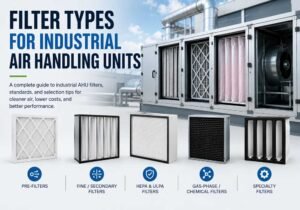
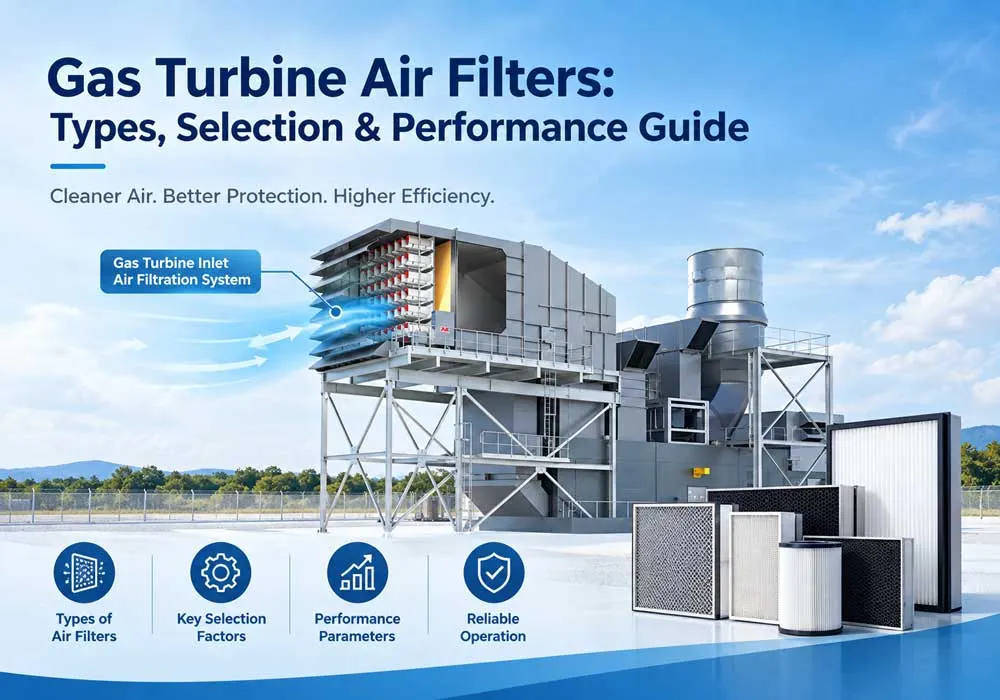
Two identical gas turbines. Same model, same fuel, same operating hours. Yet one delivers 3% more power output, requires 40% fewer unplanned shutdowns, and extends hot-section inspections by 18 months. The difference? Gas turbine air filters done right.
Your inlet air filtration system is the first and most critical line of defense against airborne contaminants that cause compressor fouling, corrosion, and performance degradation. Choosing the wrong filter type doesn’t just increase pressure drop; it accelerates wear, spikes fuel consumption, and can trigger catastrophic blade damage.
This guide provides a detailed overview of gas turbine air filters. Whether you are specifying filters for combined-cycle power plants, offshore platforms, or industrial cogeneration facilities, you can select the right gas turbine air filter for your specific operating environment.
Why Do Gas Turbine Need Air Filter?
Gas turbine ingest enormous volumes of air – up to 600,000 cubic meters per hour for large industrial units. Unlike internal combustion engines, turbine compressors operate at extremely high rotational speeds with tight clearances between blades and casings. This makes them uniquely vulnerable to airborne contaminants.
Without proper gas turbine inlet filtration, even microscopic particles cause cascading problems. Submicron dust (0.5-5 microns) deposits on compressor blades, disrupting aerodynamic profiles and reducing efficiency by 5-8% with just 20 microns of fouling. Salt aerosols in coastal environments trigger chloride-induced stress corrosion cracking. Abrasive silica dust in desert operations erodes protective blade coatings. Moisture ingress causes filter media swelling and structural failure.
The consequences extend beyond performance degradation. Compressor fouling increases heat rate (fuel consumption per kWh), forcing you to burn more fuel for the same output. Severe erosion or corrosion can lead to blade cracks, requiring expensive hot-section inspections or premature overhauls. In extreme cases, foreign object damage from inadequately filtered debris triggers catastrophic turbine trips.
Your gas turbine air filter is the first, and most cost-effective line of defense. A well-specified filtration system extends maintenance intervals, preserves rated power output, and protects your capital investment from preventable damage.
Types of Gas Turbine Intake Air Filters
Gas turbine inlet air filtration systems use multi-stage configurations to balance efficiency, pressure drop, and maintenance frequency. Understanding these categories is essential for specifying the right system for your environment.
Inertial Separators and Weather Hoods
These are the first line of defense, installed at the air intake before any filter media.
Function: Remove large particles (>10 microns), water droplets, rain, snow, and debris through centrifugal force and gravitational settling.
Common Types:
- Vane-type inertial separators: Use angled blades to create cyclonic action, removing 80-95% of particles larger than 5-10 microns.
- Weather hoods with bird screens: Prevent rain ingress and block animals, leaves, and large debris.
- Coalescing pre-separators: Remove liquid water and aerosols in offshore or high-humidity environments.
Typical Applications: All gas turbine installations, especially coastal, offshore, and desert environments.
Tip: Never skip inertial separation. It extends pre-filter life by 2-3× and protects filter media from water damage.
Pre-Filters (Coarse Filtration Stage)
Pre-filters are the first media-based filtration stage in a gas turbine inlet filtration system, installed after inertial separators but before final high-efficiency filters or coalescers.
Function: Captures particles between 5-10 microns, such as coarse dust, sand, pollen, insect debris, and lint. By removing these larger contaminants early, pre-filters extend the life of expensive final filters by 50-100% and prevent premature clogging of high-efficiency stages.
Common Types:
- Panel filters (flat or pleated): Cost-effective, low initial pressure drop (<100 Pa), suitable for general particulate removal in clean to moderate environments. Typically G4 or MERV 8-10 rated.
- Bag filters (V-bank or pocket): Higher dust-holding capacity (800-1200g), ideal for commercial and light industrial applications with extended service intervals. F7-F9 (EN 779) or ISO ePM10 60-70% efficiency.
- High-loft wraps/socks: Easy-to-replace pre-layers for coarse contaminant capture in high-dust environments. Often used as sacrificial layers in desert or mining operations.
- Synthetic media pads: Higher dust-holding capacity than fiberglass, washable options available, used in commercial AHUs and light industrial gas turbine air filter systems.
Standards & Classifications:
- ISO 16890: ISO Coarse to ePM10 50-70%.
- EN 779 (legacy): G4, M5 classes.
- ASHRAE 52.2: MERV 8-11.
Typical Applications: Used in combined-cycle plants, industrial cogeneration, compressor stations, and as the first stage in multi-stage gas turbine inlet filtration systems.
Selection Insight: In high-dust environments (deserts, cement plants), use two-stage pre-filtration: inertial separator + MERV 10 pre-filter. This extends final filter life significantly and reduces total maintenance costs.
Final Filters (High-Efficiency Stage)
Final filters are the last barrier before air enters the turbine compressor in a gas turbine intake air filter system. They capture the submicron particles that cause the most damage to compressor blades and hot-section components.
Function: Remove particles between 0.3-5 microns, such as fine dust, salt crystals, combustion aerosols, bacteria carriers, and industrial pollutants that cause compressor fouling and performance degradation.
Common Types:
- Pleated cartridge filters (nanofiber media): Synthetic media with an electrostatic charge, rated ISO ePM1 70-90% or MERV 13-16. High surface area (15-25 m² per cartridge) and dust-holding capacity (1200-2000g).
- Compact HEPA filters (H13-H14 / E10-E12 per EN 1822): For ultra-clean environments (semiconductor, pharmaceutical) requiring ISO 29461 T12-T13 performance. Efficiency ≥99.95% at MPPS.
- Hydrophobic cartridge filters: Membrane or composite coatings resist moisture and salt, critical for coastal and offshore installations. W-rating W4-W6 per ISO 29461 water spray testing.
- Barrier filters: High-efficiency final stage in extreme conditions, often paired with pre-filters in three-stage systems. E12 / MERV 16 equivalent performance.
- Offshore-specific filters: Specially designed for low and medium-velocity offshore filter housings, eliminating frequent water washing while maintaining EPA efficiency grades.
Standards & Classifications:
- ISO 29461-1: T9-T13 classes for turbomachinery (T12 = ≥99.5% efficiency at MPPS, T13 = ≥99.95%).
- ISO 16890: ePM1 70-95%.
- ASHRAE 52.2: MERV 13-16 (MERV 16 ≈ E12 / ISO T12).
- EN 1822: E10-E12 (EPA), H13-H14 (HEPA).
Typical Applications: Power generation, offshore platforms, coastal installations, desert operations, and industrial facilities with high particulate loading.
Critical Warning: Never use HEPA filters in standard turbine inlet systems without verifying fan capacity. HEPA creates 3-5× more pressure drop than MERV 13-15 filters, risking airflow starvation and compressor surge. For offshore applications, specify filters with both high efficiency (Er5) and maximum watertightness (W5) to prevent moisture carryover and compressor efficiency losses.
Moisture Separators or Coalescing Filters
Moisture separators and coalescing filters are critical components in gas turbine inlet air filter systems for coastal, offshore, tropical, and high-humidity environments. They remove liquid water and aerosols that would otherwise cause filter media swelling, structural failure, and compressor corrosion.
Function: Remove liquid water droplets, salt aerosols, and fine mist from the intake airstream before they reach particulate filters or the turbine compressor.
Common Types:
- Vane-type moisture separators: Use streamlined profiles to change airflow direction, causing water droplets to impinge on vane surfaces and drain away. Suitable for horizontal or vertical flow, face velocities 3-5 m/s, pressure drop <50 Pa.
- Coalescing panel filters: Specialized media that pulls fine water droplets and aerosols out of the airstream by coalescing them into larger droplets that drain by gravity. Standard on marine propulsion and coastal installations.
- Multi-stage moisture eliminators: Combine vane separators with coalescing pre-filters or bag filters to achieve efficiencies from ISO Coarse 70% up to ePM1 50%, depending on application requirements.
- Hydrophobic cartridge filters: Specifically engineered for heavy rain, fog, and salt-laden air, preventing moisture penetration while maintaining stable pressure drop. Rated W4-W6 per ISO 29461 water spray testing.
Performance Metrics:
- Watertightness (W-rating): W0-W5 per ISO 29461, with W5 indicating highest moisture resistance.
- Separation efficiency: 95-99% for droplets >10 microns, 80-90% for droplets 3-10 microns.
- Pressure drop: Typically 50-150 Pa for coalescing stages, depending on face velocity and media type.
Typical Applications: Offshore platforms, coastal power plants, LNG facilities in tropical climates, marine propulsion systems, and any installation experiencing rain, fog, or salt spray.
Reality Check: Coalescer panel filters address moisture and salt, not dust. They remove fine water droplets and aerosols from the airstream before it reaches the particulate stages, which is why they’re standard on marine propulsion and coastal installations rather than dry onshore sites. In humid tropical conditions, watertight filters with a W5 rating can prevent 3-5% compressor efficiency losses and 15-20% power losses caused by moisture carryover.
Gas-Phase and Chemical Filters (optional)
In specific environments, gaseous contaminants require chemical filtration in addition to particulate removal in a gas turbine inlet filtration system.
Function: Remove corrosive gases (SO₂, NOₓ, H₂S, Cl₂), VOCs, and acid mists that cause turbine corrosion, hot-section degradation, and component failure.
Common Types:
- Activated carbon filters: Adsorb VOCs, odors, and organic compounds. Effective for general gas-phase removal in refineries and chemical plants. CTC (Carbon Tetrachloride Activity) ≥60% indicates good performance.
- Chemical impregnated media: Potassium permanganate, copper oxide, or other agents target specific gases (e.g., sulfur compounds, ammonia, chlorine, mercury).
- Hybrid filters: Combine particulate and gas-phase filtration in a single cartridge, reducing space requirements and simplifying maintenance. Ideal for retrofit applications where space is limited.
- Deep-bed carbon filters: Greater media depth (50-100mm) provides longer residence time and higher removal efficiency compared to thin coated panels.
Performance Metrics:
- CTC (Carbon Tetrachloride Activity): ≥60% indicates good general VOC removal.
- Residence Time: Longer contact time between air and media = higher removal efficiency. Deep-bed filters (50-100mm) outperform thin coated panels (10-20mm).
- Breakthrough Time: Time until the gas concentration downstream reaches 10% of the inlet concentration. Typically 6-12 months for carbon filters at moderate gas concentrations.
Typical Applications: Refineries, chemical plants, wastewater treatment facilities, coastal installations with industrial pollution, urban areas with high NOₓ/SO₂ levels, and geothermal power plants with H₂S concerns.
Reality Check: Standard particulate gas turbine air filter media do nothing for gaseous contaminants. If you operate near refineries or chemical facilities, you need activated carbon or chemical media, not just higher MERV ratings. Replace gas-phase filters every 6-12 months or when gas breakthrough is detected via downstream monitoring.
Key Performance Requirements for Gas Turbine Air Filter
When evaluating gas turbine inlet air filter options, focus on these critical performance parameters. They determine whether a filter will protect your turbine or create operational problems.
Filtration Efficiency (ISO 29461-1): This is the most important metric. ISO 29461-1 is the only international standard specifically designed for turbomachinery inlet filtration. It classifies filters from T1 (coarse) to T13 (high efficiency), based on efficiency at the Most Penetrating Particle Size (MPPS), typically 0.12-0.25 microns.
- T9-T10 (ePM1 70-80%): Suitable for clean inland environments.
- T11-T12 (ePM1 85-90%+): Recommended for coastal, desert, or industrial settings.
- T13 (ePM1 >95%): Ultra-high efficiency for critical applications.
Pressure Drop (ΔP): Every inch of water gauge (in. wg) in inlet system pressure drop reduces power output by 0.5-0.8%. Key benchmarks:
- Initial pressure drop: New, clean filter at rated airflow. Target <250 Pa (1 in. wg) for final filters.
- Final pressure drop: Maximum operating resistance before replacement. Typically 2-3× initial ΔP, or ≤1000 Pa (4 in. wg).
- Total system ΔP: Include inertial separators, pre-filters, final filters, and ductwork. Target <1500 Pa (6 in. wg) for optimal performance.
Dust-Holding Capacity: Measured per ISO 29461 using standardized test dust (ISO 12103-1 A2 fine test dust). Higher capacity = longer service life and lower maintenance costs. Look for filters with dust retention ≥1200g at 2.5 in. wg final resistance.
Moisture Resistance (W-Rating): Critical for coastal, offshore, and high-humidity environments. ISO 29461 includes water spray testing to verify filter integrity under wet conditions.
- W1-W3: Light to moderate moisture resistance.
- W4-W6: High resistance, suitable for coastal and offshore installations.
Always specify hydrophobic or water-resistant media if your site experiences rain, fog, or salt spray.
Structural Integrity: Filters must maintain performance at elevated pressure drops without media collapse, frame deformation, or seal leakage.
How to Choose the Right Air Filter for Gas Turbine?
Selecting filters isn’t about chasing the highest rating. It’s about matching performance to your specific environment while respecting system constraints. Follow this decision framework:
Match Filter to Environmental Conditions
Start by assessing your site’s contaminant profile:
- Clean inland environments (low dust, no salt): ISO T9-T10 (ePM1 70-80%) or MERV 11-13 final filters with MERV 8 pre-filters.
- Coastal installations (salt aerosols): ISO T11-T12 (ePM1 85-90%) with coalescing pre-separators for water removal.
- Desert operations (high silica dust): ISO T12-T13 (ePM1 90-95%) with two-stage pre-filtration (inertial + MERV 10).
- Industrial/urban pollution (SO₂, NOₓ, VOCs): ISO T11-T12 with activated carbon or chemical media for gas-phase removal.
- Offshore platforms (salt spray + high humidity): ISO T12-T13 with weather hoods, coalescers, and corrosion-resistant housings.
Tip: Don’t over-filter. Installing T13 in a clean inland environment wastes energy without measurable performance benefits. Match the filter to the risk.
Consider System Compatibility & Pressure Drop
Every filter creates pressure drop (ΔP). Higher efficiency = higher ΔP = reduced power output. Before upgrading:
- Check turbine manufacturer specifications. Most industrial turbines max out at ISO T12 or MERV 15. Going higher risks compressor surge.
- Calculate total inlet system ΔP. Include inertial separators, pre-filters, final filters, and ductwork. Target total ΔP <6 in. wg (1500 Pa) for optimal performance.
- Evaluate self-cleaning options. If your environment has high dust loading (>500 μg/m³), pulse-jet systems maintain stable ΔP and extend filter life by 3-5×.
Rule of Thumb: Every 1 in. wg (250 Pa) increase in inlet ΔP reduces power output by 0.5–0.8%.
Maintenance & Replacement Schedule
Filters don’t last forever. Clogged filters increase ΔP, reduce airflow, and compromise efficiency. Follow these guidelines:
| Filter Type | Replacement Frequency | Notes |
|---|---|---|
| Inertial separators | Inspect quarterly, clean annually | Washable, reusable |
| Pre-filters (MERV 8-10) | 3-6 months | Disposable, low cost |
| Final filters (ISO T9-T11) | 12-18 months | Depends on pre-filtration quality |
| Final filters (ISO T12-T13) | 18-24 months | With proper pre-filtration |
| Pulse-jet cartridges | 3-5 years | Self-cleaning extends life significantly |
| Activated carbon filters | 6-12 months | Replace when gas breakthrough detected |
Warning Signs: Rising differential pressure (>20% above baseline), decreased power output, increased heat rate, or visible dust on downstream surfaces.
Best Practice: Install differential pressure sensors across filter banks. Set alarms at 150% of the clean-filter ΔP to trigger inspection or replacement.
Conclusion
A gas turbine air filter is an important component of the inlet filtration system, helping control airborne contaminants before they reach the compressor. Its performance can influence the balance between equipment protection, airflow resistance, maintenance requirements, and operating costs.
When selecting a gas turbine inlet air filter, you should look beyond a single efficiency rating. Consider the operating environment, contaminant characteristics, airflow requirements, pressure drop, dust-holding capacity, filter service life, sealing performance, and overall system compatibility.
If you are looking for a customized gas turbine air filter or need support evaluating your existing gas turbine inlet filtration system, CENCARB can help you assess relevant filtration requirements, filter dimensions, media options, and performance specifications to develop a suitable air filtration solution.