A higher-efficiency particle filter does not automatically solve every air-quality problem. An HVAC system may capture visible dust effectively while VOCs, solvent vapors, traffic-related odors, and other gaseous contaminants continue moving through the airstream. That is because these pollutants do not behave like particles: they exist as molecules or vapors and require a different filtration mechanism.
An activated carbon air filter is designed for this gap. Rather than trapping particles in fibrous media, it uses porous carbon to adsorb selected gases and odors. The right filter can support odor control, improve indoor air quality, and help protect sensitive equipment or processes—but only when its carbon media, loading, airflow, and operating conditions match the actual contaminant. This guide explains how activated carbon filtration works, what it can remove, where it is used, and how to select the right solution for your application.
What is an Activated Carbon Air Filter?
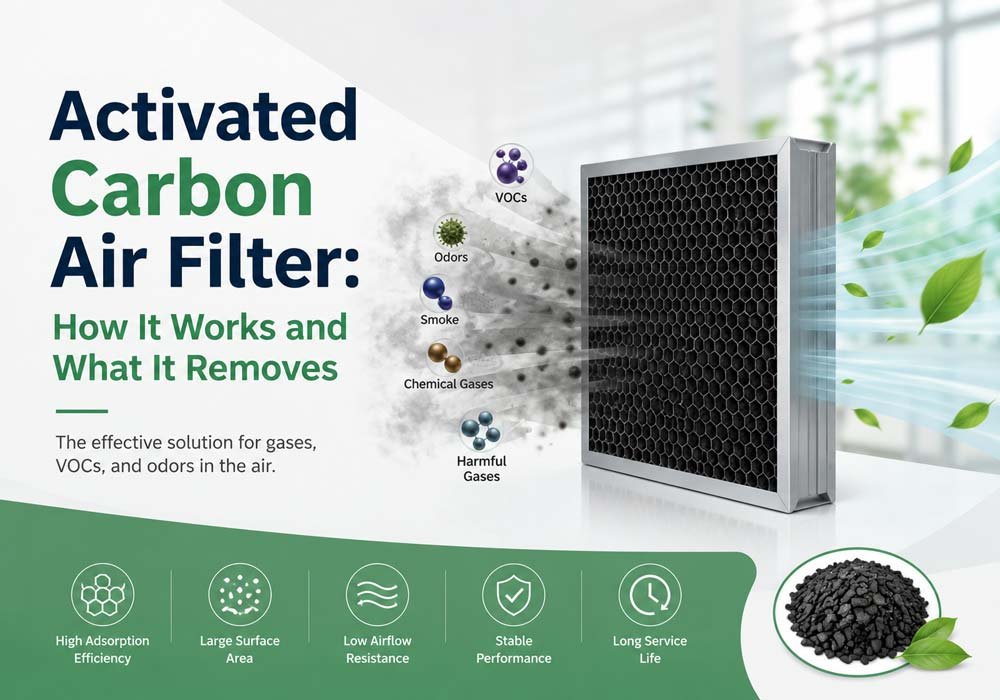
An activated carbon air filter is a gas-phase filtration device designed to reduce selected gases, vapors, and odors from an airstream. It may also be described as an activated charcoal filter, carbon air filter, or carbon filter for HVAC and industrial ventilation systems.
The key material is activated carbon: a processed carbon-based adsorbent with a highly developed internal pore structure. Carbon may be produced from coconut shell, coal, wood, or other carbonaceous raw materials. However, the raw material alone does not determine performance. Pore distribution, surface chemistry, particle size, carbon mass, bed depth, and the target contaminant all affect the filter’s real adsorption capability.
Unlike a pre-filter, fine filter, or HEPA filter, an activated carbon air filter is not primarily intended to remove dust, fibers, pollen, or other airborne particles. Its main role is gas-phase air filtration. It is commonly installed in HVAC systems, air handling units, fresh-air systems, recirculation systems, commercial ventilation equipment, industrial process ventilation, and air purification units.
The filter media should be selected according to the contaminant rather than particle size. Standard activated carbon is commonly used for many organic vapors and odors, while chemically impregnated carbon or other reactive media may be selected for gases that require more specific chemical treatment.
How Does an Activated Carbon Air Filter Work?
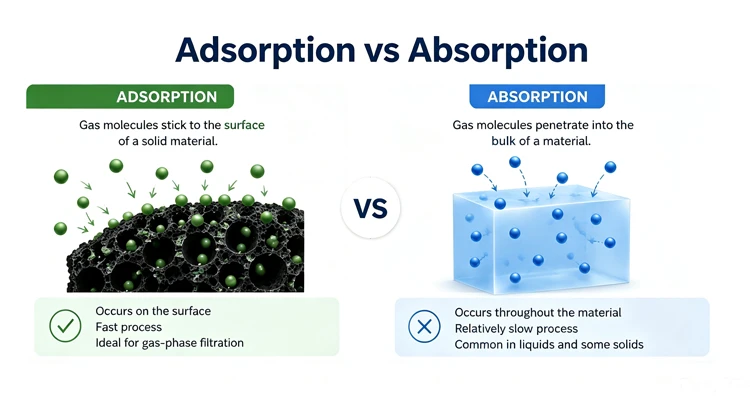
Activated carbon filtration is based mainly on adsorption. This is a surface process in which compatible gas molecules adhere to the external and internal surfaces of the carbon media. It is different from absorption, where a substance enters and becomes distributed throughout another material.
Activated carbon has a network of pores of different sizes. When contaminated air passes through the filter, certain gas molecules are drawn into these pores and retained on the carbon surface. The process is influenced by the chemical properties of the pollutant and the physical properties of the carbon. It is not simply a matter of air passing through a “black filter.”
The performance of an activated carbon air filter depends on several connected factors: the target gas, carbon type, carbon weight, media depth, airflow, face velocity, temperature, humidity, and required outlet concentration. The same filter may perform differently in two systems if the airflow or contamination level changes.
Adsorption is Not the Same as Absorption
In gas-phase filtration, the distinction matters. Activated carbon primarily adsorbs contaminants onto its porous surfaces. The large internal surface area increases the number of available sites where compatible molecules can be retained.
This mechanism works well for many organic molecules, particularly those that are readily adsorbed under the operating conditions. It is less reliable for some highly volatile, low-molecular-weight, or highly polar gases unless the media has been modified or combined with a reactive treatment.
For buyers, the practical message is simple: an activated carbon filter should be chosen for a named contaminant or a known contaminant group. “Odor removal” alone is not enough information for a reliable selection, because the chemistry behind an odor determines which media will work.
Why Carbon Loading and Contact Time Matter
An activated carbon filter needs sufficient interaction time between the air and the media. If air moves too quickly through a shallow filter, gas molecules may not have enough opportunity to reach and adsorb within the carbon pores.
Carbon loading refers to the quantity of activated carbon available in the filter. A higher media load or deeper bed can generally provide more adsorption capacity and longer contact time, but it may also increase pressure drop, weight, and installation depth. This is why a thin carbon-loaded web filter, a honeycomb carbon filter, and a deep-bed granular carbon module cannot be expected to provide the same service life or removal performance.
You should evaluate carbon loading together with airflow and the required service life. A low-pressure-drop filter may be appropriate for a low-level odor-control application, while a higher-capacity granular carbon filter may be more appropriate for continuous industrial vapor exposure.
Humidity and Temperature Affect Performance
Humidity is one of the most important operating conditions in gas-phase filtration. Water vapor can compete with some contaminants for adsorption sites, which may reduce the performance of physical adsorbents under certain conditions. Temperature can also influence adsorption capacity and the rate at which a contaminant breaks through the media.
This is especially relevant in high-humidity environments such as wastewater treatment plants, food facilities, outdoor-air systems, and certain chemical processes. If your application operates at elevated humidity or temperature, that information should be part of the filter specification—not an afterthought during installation.
ISO 10121 describes laboratory methods for evaluating gas-phase air-cleaning media and devices. Its test frameworks emphasize that performance should be interpreted under stated conditions, including the challenge gas, concentration, airflow, temperature, humidity, and media configuration.
What Does an Activated Carbon Air Filter Remove?
Activated carbon can adsorb a wide range of gaseous pollutants, but its performance varies significantly by compound. The most accurate answer is not that carbon “removes all gases,” but that it can be selected to treat many compatible gases and vapors under suitable design conditions.
VOCs and Organic Vapors
Activated carbon is widely used for many VOCs and organic vapors. These may come from paint and coating operations, printing, cleaning solvents, adhesives, resins, laboratory work, packaging processes, and manufacturing activities.
Examples can include portions of hydrocarbons and solvent vapors, depending on the compound and operating conditions. However, the term VOC covers a large group of chemicals with different adsorption behavior. You should not assume that a filter rated for one solvent will provide the same result for another.
For a reliable activated carbon filter recommendation, provide the chemical name or safety data sheet where possible. This allows the supplier to assess whether standard activated carbon is appropriate or whether impregnated or composite media should be considered.
Odors
Activated carbon filters are commonly used for odor control because many nuisance odors contain organic vapors that can be adsorbed by carbon. Typical applications include commercial kitchens, waste rooms, airports, public buildings, food processing, storage areas, and selected industrial processes.
However, odor is not a technical contaminant category. A wastewater odor may involve hydrogen sulfide and ammonia; a chemical-process odor may involve acids, amines, or solvents; a building odor may involve VOCs from materials or cleaning products. The source matters.
For mixed or reactive odors, untreated activated carbon may not provide enough performance. A chemically impregnated carbon or multi-media chemical filter may be necessary, especially where hydrogen sulfide, ammonia, acid gases, or alkaline gases are present.
Smoke-Related Gases and Fumes
Activated carbon may help reduce some gaseous components and odors associated with smoke or fumes. It does not replace the particle-filtration stages required to capture smoke particles, soot, or fine aerosols.
Where smoke is a routine process contaminant, the system may require a combination of pre-filtration, fine filtration, HEPA filtration where appropriate, and activated carbon or chemical media for gas-phase components. For fire smoke, emergency releases, or hazardous high-concentration exposures, standard HVAC carbon filters should not be treated as a substitute for properly designed safety controls or respiratory protection.
Formaldehyde, Acidic Gases, Alkaline Gases, and H₂S
Standard activated carbon may have limited performance for formaldehyde, ammonia, hydrogen sulfide, nitrogen oxides, and certain acidic or alkaline gases, particularly where humidity is high or contact time is limited. For these applications, carbon media may need chemical impregnation or may be combined with activated alumina, potassium permanganate, or other reactive media.
This is an important selection point. A product labelled “activated carbon filter” does not automatically provide reliable removal of formaldehyde, ammonia, H₂S, acid gases, or all odors. You can ask for CENCARB air filter supplier recommendation based on the actual contaminant, its concentration, airflow, humidity, and the required service life.
What Activated Carbon Filter Do Not Remove?
An activated carbon air filter should not be treated as a universal air-cleaning solution. Its main function is gas-phase adsorption, not high-efficiency particle filtration.
Carbon media does not replace a pre-filter, fine filter, or HEPA filter for dust, pollen, metal particles, smoke particles, bacteria-carrying aerosols, or other particulate contaminants. If particle control is required, use the appropriate particle filter stage before or after the carbon filter, according to system design.
Activated carbon also does not eliminate the need for source control and ventilation. Where a process releases high concentrations of toxic, flammable, or regulated gases, the first priorities are usually process containment, local exhaust ventilation, safe handling practices, and compliance with applicable regulations. Air cleaning may support these controls, but it should not be treated as the sole protective measure.
Types of Activated Carbon Air Filters
There is no single activated carbon filter structure that fits every gas-phase application. The right design depends on media quantity, airflow, contact time, pressure drop, installation space, and the pollutant load.
Carbon-Loaded Web Filters
Carbon-loaded web filters combine activated carbon with a fibrous structure. They are relatively compact and can provide low resistance where moderate gas-phase control is required. They are commonly considered for HVAC systems, commercial buildings, and general odor and VOC control.
Granular Activated Carbon Filters
Granular activated carbon filters contain loose or retained carbon granules with a larger quantity of sorbent than many thin carbon-loaded media. Their greater media volume can be advantageous where longer contact time or higher adsorption capacity is required.
Honeycomb Activated Carbon Filters
Honeycomb carbon filters use a structured channel design to provide a large air-contact area within a compact configuration. They are useful when installation space and pressure drop are important considerations.
However, a honeycomb activated carbon filter should still be regarded primarily as a gas-phase filter, not as a high-efficiency particle filter. Where dust loading is expected, an upstream particulate filter should normally be provided.
V-Bank Activated Carbon Filters
V-bank designs arrange multiple filter sections in a V-shaped configuration to increase the available media area within the filter footprint. They are well suited to higher-airflow HVAC and industrial applications where greater carbon loading and airflow capacity are required.
Impregnated Activated Carbon Filters
When standard activated carbon does not provide sufficient control for a specific reactive gas, the carbon may be chemically impregnated. These filters combine adsorption with a chemical reaction and can be formulated for selected contaminants such as acidic or alkaline gases.
Where is Activated Carbon Air Filter Used?
Activated carbon filter is used wherever gaseous contaminants, odors, or molecular pollutants need to be controlled.
Typical applications include commercial HVAC systems, hospitals, laboratories, pharmaceutical facilities, semiconductor and electronics manufacturing, chemical plants, wastewater treatment facilities, airports, food-processing environments, and other industrial or commercial buildings.
The reason for using activated carbon varies by application. A commercial building may primarily require odor and VOC control, while a semiconductor facility may be concerned with molecular contaminants that can affect sensitive processes. A wastewater treatment plant may have a much stronger focus on odor and sulfur-containing gases.
The filter should therefore be designed around the contaminant profile of the site, not simply selected because it is labeled “activated carbon.”
How to Choose the Right Activated Carbon Air Filter?
Choosing an activated carbon air filter begins with identifying the contaminant. If the issue is described only as “odor,” ask where it comes from and whether there is available air sampling or process information. A filter selected for VOCs may not be suitable for hydrogen sulfide or ammonia.
You can provide the CENCARB manufacturer with the target contaminant, average and peak concentrations, total airflow, airflow per filter, required filter dimensions, available installation depth, temperature, relative humidity, operating hours, maximum acceptable pressure drop, and target service life. If the system already contains pre-filters, fine filters, or HEPA filters, include that information as well.
The best activated carbon filter is not necessarily the filter with the lowest pressure drop or the highest carbon weight. It is the filter that matches the contaminant, airflow, installation limits, and maintenance strategy. A technically sound recommendation should explain why a particular media type and filter structure are appropriate for your conditions.
Conclusion
An activated carbon air filter is a specialized gas-phase filtration solution for pollutants that particle filters cannot reliably capture. It works through adsorption, using porous carbon media to retain selected VOCs, organic vapors, odors, and other compatible gaseous contaminants.
To select the right filter, start with the contaminant rather than the product label. When you match the carbon media, filter structure, airflow, contact time, humidity, and carbon loading to your application, activated carbon filtration can provide a practical and reliable addition to HVAC and industrial air treatment systems.