Dust and particles are only part of the air quality problem. Many pollutants exist as invisible gases and vapors that can cause odors, corrosion, irritation, and even contamination of manufacturing processes. In such cases, chemical filter (also known as gas-phase filter) can effectively adsorb and removes invisible vapors, odors, toxic gases, and chemical contaminants from the air, helping protect both equipment and human health. This article provides a detailed overview of how chemical filters work, their key advantages, major types, and common applications.
What is Chemical / Gas-Phase Filter?
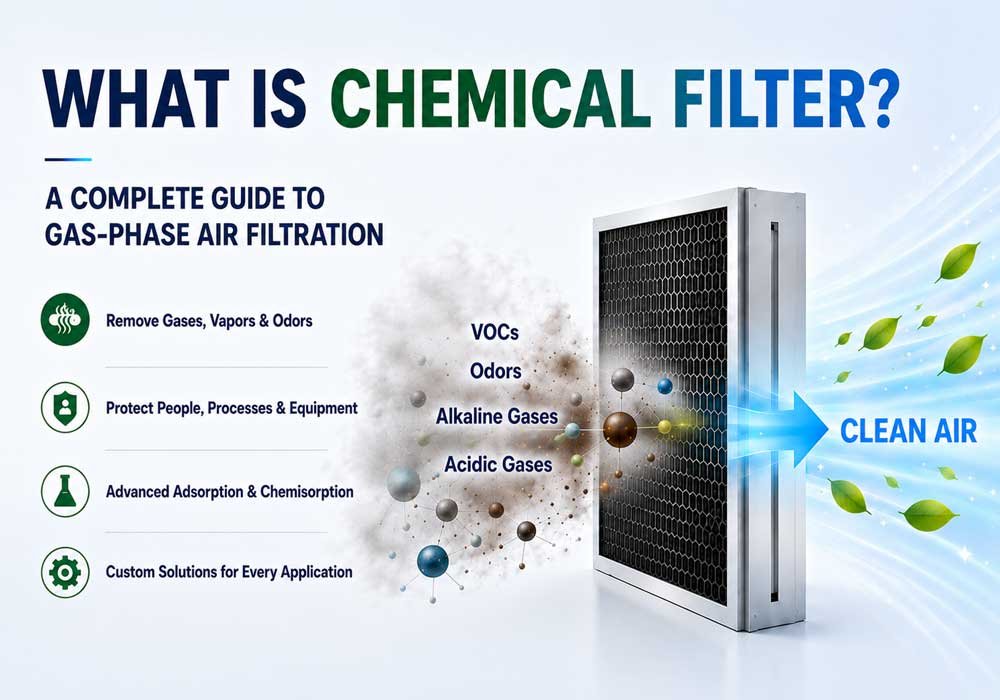
Chemical filter is a specialized gas-phase air-cleaning device designed to remove gaseous and vapor-phase contaminants rather than relying only on mechanical particle capture. In the HVAC and industrial air filtration industry, it is also commonly called a gas-phase filter, gas-phase air cleaner, or molecular air filter.
The main purpose is to reduce contaminants that may cause odor, irritation, toxicity, corrosion, or damage to equipment and materials. Typical targets include:
- VOCs and solvent vapors
- Odors and nuisance gases
- Formaldehyde and other aldehydes
- Ammonia and amines
- Hydrogen sulfide (H₂S)
- Sulfur dioxide (SO₂)
- Nitrogen oxides (NOₓ)
- Chlorine and certain reactive gases
- Acidic and alkaline gases
- Other application-specific chemical contaminants
The media used in a chemical air filter is selected according to the contaminant rather than simply according to particle size. Activated carbon is widely used for physical adsorption of many organic vapors, while chemically impregnated media can be selected when a contaminant requires a more specific chemical reaction.
How Do Chemical Filter Works?
Commercial gas-phase air cleaning remove gaseous contaminants mainly through adsorption, chemisorption, or a combination of both. Some specialized gas-phase air-cleaning systems may also use absorption, catalytic reactions, or composite treatment mechanisms.
Adsorption
Adsorption occurs when gas molecules attach to the surface and internal pore structure of a solid material. It is different from absorption, in which a substance enters and becomes distributed throughout another material.
Activated carbon is widely used because its developed pore structure provides a large internal surface area. When contaminated air passes through the carbon, suitable gas molecules are retained within the pore network.
The performance of adsorption depends on the pollutant’s chemical properties, the pore structure of the carbon, the amount of media, airflow, contact time, temperature, humidity, and the presence of competing gases.
Adsorption is not equally effective for every gas. Activated carbon may perform well for many organic vapors and VOCs, but untreated carbon may have limited effectiveness against certain gases, including ammonia, hydrogen sulfide, nitrogen oxides, or formaldehyde. In these cases, specially treated or reactive media may be required.
Chemisorption
Chemisorption involves a chemical reaction or stronger chemical binding between the contaminant and the treatment medium. It is particularly useful for gases that are not adequately controlled by standard activated carbon alone.
For example, specially impregnated carbon can be formulated for ammonia or acid gases, while potassium-permanganate-impregnated alumina is another type of chemisorbent used for selected reactive gases.
The practical advantage is that the media can be chemically tailored toward a particular contaminant. Therefore, when you need to remove acidic gases, alkaline gases, ammonia, H₂S, or other reactive compounds, choosing the correct impregnated media can be more important than simply increasing the amount of standard carbon.
Why Airflow and Contact Time Matter
A gas-phase filter must provide sufficient interaction between the contaminated air and the sorbent. Air velocity, media depth, carbon loading, and filter geometry all influence performance.
For industrial applications, a deeper media bed can provide greater contact time and adsorption capacity than a thin carbon-loaded filter. However, the correct design must balance removal performance with pressure drop, airflow requirements, equipment capacity, and operating cost.
Humidity is another important consideration. High relative humidity can reduce the performance of physical adsorbents such as activated carbon because water molecules compete for adsorption sites.
The Advantages of Chemical Filter
Chemical filters provide a specialized solution for air contaminants that conventional particle filters cannot effectively remove.
Gas-Phase Contaminant Removal
Depending on the media, a chemical filter may target selected VOCs, solvent vapors, odors, acid gases, alkaline gases, sulfur compounds, ozone, and other molecular contaminants. This is especially useful when the air appears free of dust but still contains invisible pollutants.
Odor Control
Chemical filter can help control odors in wastewater treatment plants, food-processing facilities, chemical plants, laboratories, hospitals, airports, and commercial buildings.
Odor is not a single contaminant. It may be caused by VOCs, hydrogen sulfide, ammonia, amines, aldehydes, or mixed gases. Effective odor control therefore begins with identifying the emission source and selecting media that are suitable for the actual compounds.
Protection of Equipment and Processes
Some airborne gases are corrosive or chemically reactive. They can affect metal surfaces, electronic components, HVAC equipment, production tools, and sensitive manufacturing processes.
In semiconductor, electronics, pharmaceutical, chemical, and precision-manufacturing environments, chemical filtration may help reduce the concentration of molecular contaminants entering protected areas.
Flexible HVAC Integration
Chemical filters are available in a range of designs for HVAC retrofits and new construction. Common options include carbon-loaded web filter, V-bank gas-phase filter, honeycomb activated carbon filter, granular carbon module, rigid cell, and deep-bed filter.
These configurations can be produced in standard or customized sizes. The design should be selected according to airflow, media loading, pressure drop, contact time, available space, and maintenance requirements.
Low Pressure Drop Options
Carbon-loaded web and structured honeycomb filters may provide high air permeability and relatively low resistance in suitable applications. This can be useful when the existing fan has limited pressure capacity or when the HVAC system requires a compact filter.
However, low pressure drop should not be considered separately from adsorption capacity. A filter containing less media may have lower resistance but may also have a shorter service life. The selection should balance contaminant removal, pressure drop, media loading, and total operating cost.
The Types of Chemical / Gas-Phase Filter
There is no single chemical filter design suitable for every gas-phase application. The main difference between filter types is the media, geometry, carbon loading, contact time, and target contaminant.
Honeycomb Activated Carbon Filter
Honeycomb activated carbon filter use a honeycomb-shaped carrier, often made from polypropylene or another structural material, that supports or contains granular activated carbon. The air passes through the channels and comes into contact with the carbon media.
Its advantages may include compact construction, easy handling, relatively low pressure drop, and flexible installation. Honeycomb filters may be used for selected VOCs, odors, smoke-related gases, formaldehyde, and other molecular contaminants.
A honeycomb carbon filter should not automatically be described as a high-efficiency dust or bacteria filter. Its primary function is gas-phase filtration. A pre-filter or fine filter should normally be installed upstream when particulate contamination is present.
Granular Activated Carbon Filter
Granular activated carbon filter use a deeper layer of loose carbon particles. Compared with thin carbon-loaded media, a granular bed can provide a substantially larger quantity of sorbent and greater contact with the airstream.
For demanding applications, media depth and residence time become particularly important, while also emphasizing that performance can vary significantly with filter construction and media type.
V-Bank Gas-Phase Filter
V-bank gas-phase filter contain multiple angled sections arranged in a V-shaped structure. This increases the available media area within a limited face area and can support higher airflow capacity.
V-bank activated carbon filter is commonly used in industrial HVAC systems, pharmaceutical facilities, chemical plants, electronics manufacturing, and other applications requiring molecular contaminant control. It may be designed for selected VOCs, acid gases, hydrogen sulfide, sulfur dioxide, nitrogen dioxide, ammonia, amines, and process odors.
V-bank chemical filter can also be combined with HEPA filter when the system requires both gas-phase and high-efficiency particle filtration.
Carbon-Loaded Web Chemical Filter
Carbon-loaded web filter combines activated carbon with a fibrous filter structure. It provides a relatively compact solution for applications where odor and low-to-moderate concentrations of gaseous contaminants need to be controlled.
It is often used in HVAC systems, commercial buildings, healthcare environments, and general indoor air-quality applications where low pressure drop and easy installation are important.
Impregnated Carbon Filter
Chemically impregnated carbon filter is designed by treating a sorbent with chemicals that improve its ability to react with specific gases.
This approach is especially useful when the target contaminant is poorly controlled by standard activated carbon. Examples include media designed for ammonia, amines, acidic gases, H₂S, SO₂, and other reactive compounds.
For mixed-gas environments, a combination of sorbents may be required rather than a single media type.
Conclusion
Chemical filter is not simply conventional air filters filled with activated carbon; it is specialized solutions designed to control gas-phase pollutants. Understanding how it works, the types of filter media available, the gases it can adsorb, and its applications can help you choose the right gas-phase filtration solution for HVAC systems and industrial air quality needs.