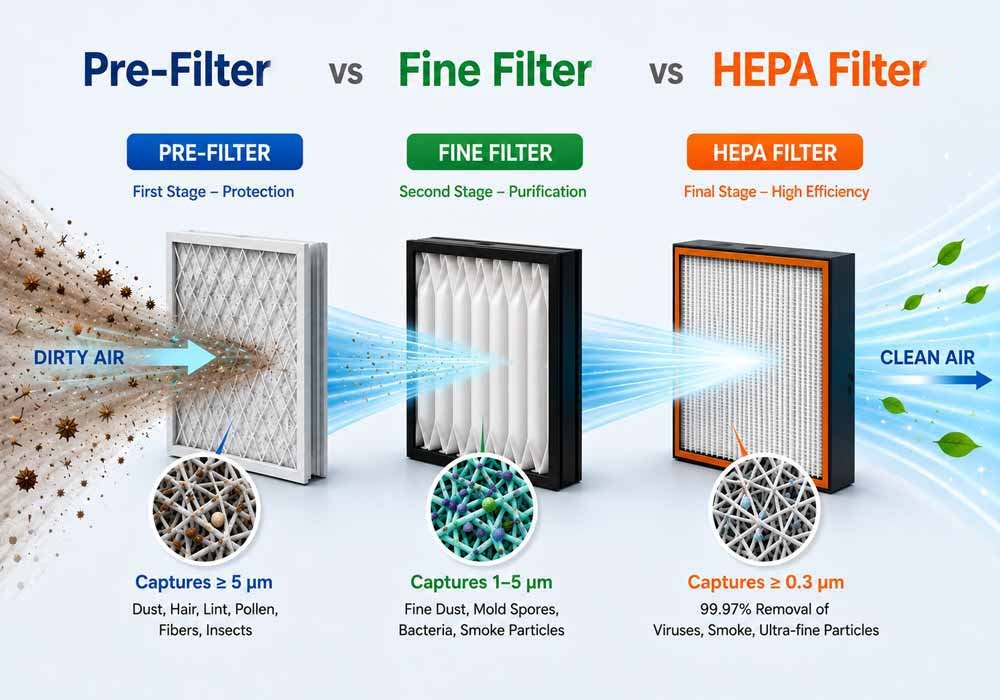
Pre-filter, fine filter, and HEPA filter are three distinct stages of air filtration—not three interchangeable levels of the same product. The pre-filter protects the system from coarse dust, the fine filter captures smaller particles, and the HEPA filter provides high-efficiency final filtration. Understanding these key differences helps you choose the right filter for your HVAC system, industrial facility, cleanroom, or other controlled environment.
What is Pre-Filter?
Pre-filter also called primary air filter or coarse air filter, is normally installed at the beginning of an air filtration system. Its main purpose is to remove larger airborne particles before the air reaches finer and more expensive filters.
Pre-filter typically capture particles 5 μm and larger, including dust, lint, fibers, pollen, hair, insects, and larger industrial particles. In factories, warehouses, commercial buildings, and outdoor air intake systems, pre-filters help reduce the amount of coarse dust entering air handling units, ventilation equipment, cooling coils, ducts, and downstream filters.
Common pre-filter designs include flat panel filter, pleated panel filter, washable metal mesh filter, and some low-efficiency bag filters. Filter media may be made from synthetic fibers, fiberglass, polyester, or other materials selected according to the required efficiency, dust-holding capacity, moisture resistance, and operating conditions.
Main Benefits of Pre-Filter
Pre-filter is widely used because they generally offer a practical balance between particle capture, low pressure drop, and economical replacement. Their principal benefits include:
- Protecting fine and HEPA filter from premature dust loading.
- Reducing contamination on coils, fans, and internal air-handling components.
- Providing relatively low resistance to airflow.
- Offering simple installation and replacement.
- Supporting economical operation in systems with high dust loads.
- Allowing customization in size, frame material, depth, and mounting configuration.
However, the pre-filter should not be treated as a final filtration solution in a cleanroom or other critical environment. Its main role is coarse-particle removal and system protection. It is also not designed to remove most gaseous contaminants, VOCs, or odors.
What is Fine Filter?
Fine filter is used to capture particles between 1 μm and 5 μm, including fine dust, pollen, mold spores, industrial aerosols, smoke-related particles, and particles that pass through the primary filter. Depending on the market, product range, and classification system, it may also be described as a medium-efficiency filter, secondary filter, fine dust filter, pocket filter, or bag filter.
Fine filter is normally installed after the pre-filter. They provide an additional level of particle removal and help reduce the contaminant load reaching a downstream HEPA filter or other final filtration stage. In some general ventilation systems, fine filter may be used as the final filter when the required level of air cleanliness does not justify HEPA filtration.
Fine filter is available in several forms, including pocket filter, multi-pocket bag filter, rigid bag filter, compact filter, V-bank filter, and pleated fine filter. The choice of structure affects the available media area, rated airflow, pressure drop, dust-holding capacity, and service life.
Main Benefits of Fine Filter
Fine filter is often selected when a system requires stronger particulate control than the pre-filter can provide but does not necessarily require a HEPA final filter. Their benefits include:
- Improved removal of fine airborne particles.
- Protection of downstream HEPA filter.
- Suitable performance for many commercial and industrial HVAC systems.
- A range of pocket depths, media types, and airflow capacities.
- Good flexibility for non-standard air handling units.
- Potentially longer service life than a small-area panel filter when properly sized.
The main selection challenge is balancing efficiency and pressure drop. Fine filter with a higher efficiency rating may capture more particles, but it may also create greater resistance to airflow. Your air handling system must be capable of operating at the selected filter’s pressure drop without unacceptable loss of airflow or excessive fan energy consumption.
What is HEPA Filter?
HEPA filter, or high-efficiency particulate air filter, is designed for applications requiring high-efficiency removal of airborne particles (> 0.3 μm). It is generally used as a final or terminal filtration stage in cleanrooms, healthcare facilities, pharmaceutical production areas, laboratories, electronics manufacturing, and other controlled environments.
Standard HEPA filtration is designed for particulate contaminants. A conventional HEPA filter should not be described as a universal air purifier because it does not, by itself, remove most gases, VOCs, or chemical vapors. If your application involves odors, solvent vapors, acidic gases, alkaline gases, or other molecular contaminants, a chemical filtration stage using activated carbon or specially selected sorbent media may also be required.
How HEPA Filter Capture Particles
HEPA filter does not operate simply as a mechanical screen with openings smaller than every particle they capture. Its performance results from several particle-capture mechanisms, including inertial impaction、direct interception、brownian diffusion, as well as additional effects that may occur depending on the filter media and construction.
The efficiency of HEPA filter must be stated together with the applicable test method and classification. In standard tests, HEPA filters are commonly associated with very high removal efficiency at a specified particle size. ASHRAE describes HEPA filter as having at least 99.97% efficiency for 0.3 μm particles under standard test conditions.
It is a test performance value, not a guarantee that the complete installed ventilation system will deliver the same result. The housing, gasket, frame, installation quality, airflow, and possible bypass leakage all affect actual system performance.
Common HEPA Filter Construction
A HEPA filter may contain:
- Fine glass-fiber or synthetic filter media
- A deep-pleat or mini-pleat media pack
- Aluminum, galvanized steel, or stainless-steel framing
- Hot-melt or aluminum separators
- Adhesive or sealant
- Continuous gasket or gel-seal system
- Protective screens
- A housing designed to minimize air bypass
For critical applications, the seal between the filter and housing is as important as the filter media itself. A high-efficiency filter that is poorly installed can allow unfiltered air to pass around the media, reducing the effectiveness of the entire air filtration system.
Key Differences Between Pre-Filter, Fine Filter, and HEPA Filter
The three filter types should not be viewed only as separate products. In many industrial air filtration systems, they are designed as complementary stages.
| Feature | Pre-Filter | Fine Filter | HEPA Filter |
|---|---|---|---|
| Primary function | Capture coarse particles and protect the system | Remove finer particles and reduce downstream loading | Provide high-efficiency particulate filtration |
| Typical position | First filtration stage | Intermediate or secondary stage | Final or terminal stage |
| Main targets | Dust, lint, fibers, pollen and larger particles | Fine dust, aerosols, spores and smaller particles | Very fine airborne particles and particulate contaminants |
| Typical construction | Panel, pleated or metal mesh | Pocket, bag, compact or V-bank | Deep-pleat, mini-pleat or separator design |
| Relative pressure drop | Usually low | Moderate | Usually higher |
| Typical applications | General HVAC and industrial ventilation | Commercial, healthcare and industrial air handling | Cleanrooms and critical environments |
| Gas-phase removal | Generally not suitable | Generally not suitable | Not provided by standard HEPA media |
| Maintenance focus | Replacement and coarse dust loading | Pressure drop and dust-holding capacity | Sealing, integrity testing, and pressure drop |
This table provides a general comparison only. Actual performance depends on the filter design, test standard, airflow, media, dimensions, installation quality, and operating environment.
How to Choose the Right Filter for Your Application
Identify the Main Contaminant
First, determine whether the main problem is coarse dust, fine particulate matter, biological particles, smoke, odor, VOCs, or chemical gases. If the system needs to handle both particles and gases, particle filters and chemical filters should normally be evaluated as separate functions.
Define the Required Air Cleanliness
A general factory ventilation system does not have the same requirements as a pharmaceutical cleanroom or semiconductor production area. Identify whether the air is used for general comfort, personnel protection, product protection, process control, contamination prevention, or sterile manufacturing.
Confirm Airflow and Dimensions
Before ordering an industrial air filter, confirm:
- Filter length, width, and depth
- Rated airflow
- Airflow per filter
- Number of filters installed
- Available installation depth
- Frame material
- Gasket or seal requirements
- Air handling unit capacity
- Operating temperature and humidity
A filter that fits physically but cannot provide the required airflow or pressure-drop performance is not a suitable replacement.
Evaluate Pressure Drop and Fan Capacity
Check the fan curve and the available pressure margin before upgrading to a higher-efficiency filter. If the selected filter creates excessive resistance, the system may experience reduced airflow, unstable pressure, higher energy consumption, or inadequate ventilation.
Scientific reviews identify face velocity, efficiency, pressure drop, and dust-holding capacity as important characteristics when evaluating air filters. These values should be considered together rather than reviewed independently.
Select the Correct Filter Combination
General examples include:
- General ventilation: Pre-filter
- Industrial HVAC: Pre-filter plus fine filter
- Cleanroom supply air: Pre-filter, fine filter, and HEPA filter
- High-dust production: High-capacity pre-filter plus fine filter and an appropriate final stage
- Particle and gas contamination: Pre-filter and fine or HEPA filtration combined with activated carbon or chemical filtration
The correct filter combination depends on the actual system. CENCARB can recommend specific filtration stages, media types, and efficiency levels for your specific application.
Conclusion
The key difference between pre-filter, fine filter, and HEPA filter lies in their position, particle-capture capability, and role within the system. Used in the right sequence, they can protect equipment, extend filter life, maintain required air cleanliness, and control operating costs. The best choice depends on your contaminants, airflow, efficiency requirements, and application—not simply the highest filter grade.