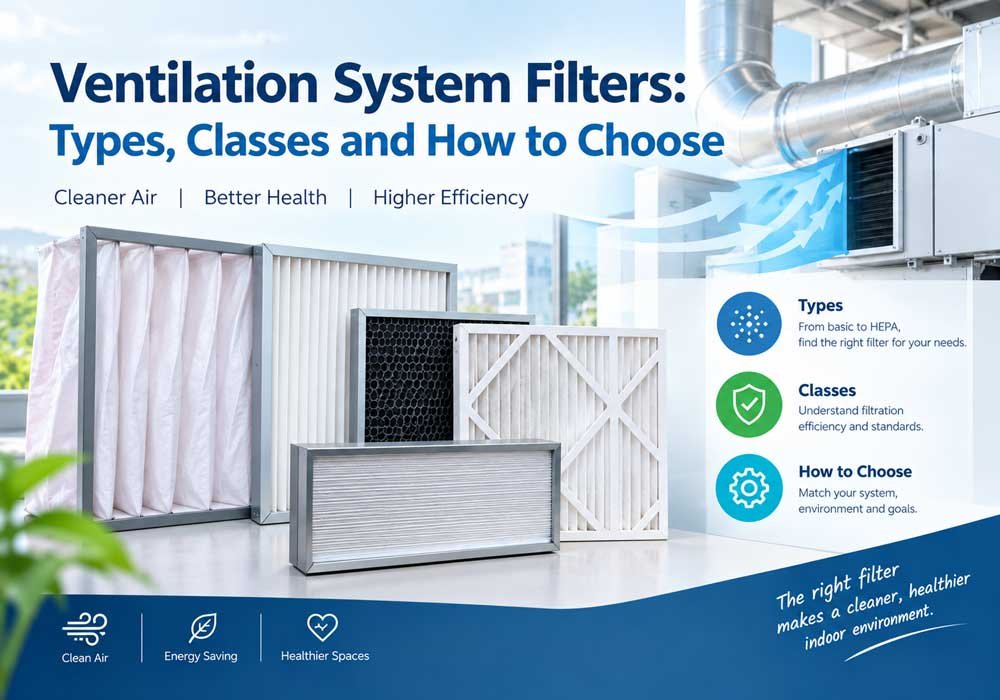
Selecting the right filter type for ventilation systems is crucial; the wrong choice can compromise air quality and lead to hidden costs related to energy consumption, equipment lifespan, and regulatory compliance. Conversely, matching the correct filter to your specific application can extend HEPA filter life by two to three times, reduce pressure drop by 30%, and cut maintenance frequency in half.
This guide provides everything you need to know about ventilation system filter types. Whether you are specifying filters for hospital cleanrooms, semiconductor plants, commercial offices, or industrial ventilation systems, you will find actionable insights based on global standards (MERV, ISO 16890, EN 1822) and real-world performance data.
Why Filter Type Matters in Ventilation Systems
Your ventilation system is only as effective as its weakest filter. Yet many buyers still choose filters based on price alone, or worse, whatever fits the rack. This approach ignores three fundamental truths:
First, filtration efficiency directly impacts indoor air quality (IAQ). A MERV 8 filter captures pollen and dust mites but lets bacteria and smoke particles pass through. A MERV 13 filter, by contrast, removes over 90% of particles as small as 1 micron, including sneeze droplets and some virus carriers. In healthcare, schools, or allergy-sensitive environments, that difference is non-negotiable.
Second, filter resistance affects energy consumption. High-efficiency filters create more airflow resistance (pressure drop). If your HVAC fan isn’t designed for it, you’ll burn more electricity trying to push air through. Studies show that upgrading from MERV 8 to MERV 13 without system adjustments can increase fan energy use by 15–25%. But pair a MERV 13 with a properly sized motor, and you gain superior air quality without the penalty.
Third, wrong filters accelerate equipment wear. Installing a HEPA filter in a residential furnace designed for MERV 8 can starve the blower of airflow, causing overheating and premature failure. Conversely, skipping pre-filters in an industrial AHU lets coarse dust clog expensive final filters within weeks, forcing costly emergency replacements.
Main Types of Ventilation System Filters
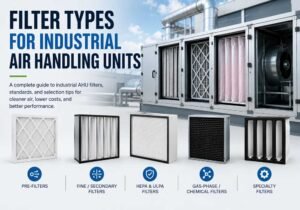
Ventilation filters fall into four functional tiers. Each serves a distinct purpose, captures specific particle sizes, and aligns with different efficiency standards. Understanding these categories is the foundation of smart filter selection.
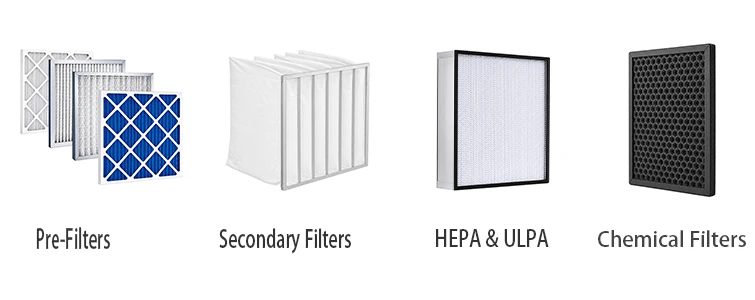
Pre-Filters (Coarse Filters)
Pre-filters are your first line of defense. Installed at the air intake or upstream of finer filters, they intercept large contaminants before they reach sensitive components.
Function: Capture particles larger than 5–10 microns-dust bunnies, hair, insects, lint, and coarse construction debris .
Common Types:
Metal mesh or nylon screens: Washable, reusable, ideal for grease-laden kitchen exhaust or industrial intakes.
Disposable fiberglass panels: Low-cost, single-use, common in basic residential units.
Synthetic media pads: Higher dust-holding capacity than fiberglass, used in commercial AHUs.
Standards & Classifications:
EN 779 (legacy): G1–G4 classes, with G4 achieving 90% arrestance on coarse dust.
ISO 16890: “ISO Coarse” designation for filters below 50% efficiency on PM10.
Typical Applications: AHU inlet sections, industrial pre-filtration stages, kitchen hood exhaust, paint booth intake.
Tip: Never skip pre-filtration in multi-stage systems. A well-maintained G4 pre-filter can extend the life of downstream F7–F9 medium filters by 50–100%.
Medium-Efficiency Filters
Medium filters bridge the gap between coarse pre-filters and high-efficiency final filters. They’re the workhorses of commercial HVAC and the final stage in many residential systems.
Function: Remove particles between 1–5 microns-pollen, mold spores, fine dust, pet dander, and some bacteria carriers.
Common Types:
Pleated filters: Folded synthetic media increases surface area, boosting capacity and efficiency (MERV 8–13).
Pocket (bag) filters: Fabric bags arranged in a V-bank configuration, offering high dust-holding capacity for commercial AHUs.
Compact cassette filters: Space-saving design for retrofits or tight mechanical rooms.
Standards & Classifications:
EN 779 (legacy): M5, M6 (medium); F7, F8, F9 (fine).
ISO 16890: ePM10 (≥50% on PM10), ePM2.5 (≥50% on PM2.5), ePM1 (≥50% on PM1).
Example: An F8 filter typically achieves ePM1 ≥70%, capturing 70% of sub-micron particles.
Typical Applications: Office buildings, schools, hospitals (general wards), light manufacturing, residential upgrades.
Selection Insight: If your downstream filter is HEPA H13, pair it with an F7–F8 medium filter. For H14 HEPA, use F8–F9. If there’s no HEPA, F7 offers the best balance of IAQ and energy efficiency.
High-Efficiency Filters (HEPA & ULPA)
When air quality requirements reach critical levels-think operating rooms, semiconductor cleanrooms, or pharmaceutical labs, only high-efficiency filters will suffice.
Function: Capture sub-micron particles down to 0.12 microns-bacteria, tobacco smoke, combustion aerosols, and virus-laden droplets.
Common Types:
EPA (Efficient Particulate Air): E10–E12, a step below HEPA for less critical applications.
HEPA (High-Efficiency Particulate Air): H13 (99.95% efficiency), H14 (99.995%) at MPPS (Most Penetrating Particle Size).
ULPA (Ultra-Low Penetration Air): U15–U17, achieving 99.9995%+ efficiency for ultra-clean environments.
Standards & Classifications:
EN 1822 / ISO 29463: Global standards defining EPA, HEPA, and ULPA classes based on MPPS testing.
MERV 17–20: Roughly equivalent to HEPA-level performance, though MERV testing uses different methods.
Typical Applications: Hospital operating theaters, cleanrooms (ISO Class 5–8), pharmaceutical manufacturing, data centers, nuclear facilities.
Critical Warning: HEPA filters create significant pressure drop. Never install them in residential HVAC systems not engineered for high static pressure. Doing so can reduce airflow by 40–60%, causing system overheating and failure.
Specialty & Gas-Phase Filters
Not all airborne threats are solid particles. Volatile organic compounds (VOCs), chemical fumes, and odors require a different filtration mechanism: adsorption.
Function: Remove gaseous contaminants-formaldehyde, benzene, toluene, cooking odors, industrial solvents, that pass right through particulate filters.
Common Types:
Activated carbon filters: Granular or pelletized carbon media with vast surface area (500–1500 m²/g) for adsorbing VOCs.
Chemical impregnated filters: Carbon treated with potassium permanganate or other agents to target specific gases (e.g., sulfur compounds, ammonia).
Hybrid filters: Combine HEPA or medium filters with carbon layers for simultaneous particle and gas removal.
Performance Metrics:
CTC (Carbon Tetrachloride Activity): ≥60% indicates good general VOC removal.
Residence Time: Longer contact time between air and carbon = higher removal efficiency. Deep-bed carbon filters outperform thin carbon-coated pleated filters.
Typical Applications: Laboratories, paint booths, wastewater treatment plants, commercial kitchens, museums, industrial exhaust systems.
Reality Check: Standard pleated filters do nothing for VOCs. If you smell chemicals or persistent odors, you need activated carbon, not a higher MERV rating.
Filter Efficiency Standards & Ratings Explained
Confused by MERV, ISO 16890, EN 779, and HEPA classes? You’re not alone. These standards measure different things, use different test methods, and apply to different filter categories. Here’s how to decode them.
MERV Ratings (ASHRAE 52.2)
What It Is: Minimum Efficiency Reporting Value, developed by ASHRAE (American Society of Heating, Refrigerating and Air-Conditioning Engineers) under Standard 52.2.
What It Measures: A filter’s ability to capture particles in three size ranges:
- 0.3–1.0 microns (E1): Smoke, bacteria, combustion particles
- 1.0–3.0 microns (E2): Mold spores, Legionella
- 3.0–10.0 microns (E3): Pollen, dust mites, carpet fibers
Scale: MERV 1–20, with higher numbers indicating greater efficiency.
| MERV Range | Captures Particles | Typical Applications | Residential Use |
|---|---|---|---|
| 1–4 | Above 10.0 microns (pollen, dust mites, sanding dust) | Minimal filtration, window AC units | Not recommended |
| 5–8 | 3.0–10.0 microns (mold spores, pet dander, hair spray) | Standard residential, light commercial | Good – baseline recommendation |
| 9–12 | 1.0–3.0 microns (Legionella, lead dust, auto emissions) | Superior residential, hospital labs | Better – good for allergies |
| 13–16 | 0.3–1.0 microns (bacteria, tobacco smoke, sneeze droplets) | Hospitals, schools, high-performance HVAC | Best – check airflow compatibility first |
| 17–20 | Below 0.3 microns (virus carriers, carbon dust) | Cleanrooms, pharmaceutical, radiological | Not for residential HVAC |
Key Insight: MERV ratings are based on a filter’s worst performance across the three size ranges, not an average. A MERV 13 filter must capture at least 50% of 0.3–1.0 micron particles, 85% of 1.0–3.0 micron particles, and 90% of 3.0–10.0 micron particles.
ISO 16890 & EN 779 (General Ventilation)
What Changed: EN 779 (G, M, F classes) was withdrawn in 2018 and replaced by ISO 16890, which aligns filtration performance with real-world health impacts.
What It Measures: Efficiency against three particulate matter (PM) fractions:
- ePM10: Particles ≤10 microns (coarse dust, pollen)
- ePM2.5: Particles ≤2.5 microns (fine dust, mold, bacteria)
- ePM1: Particles ≤1 micron (ultrafine particles, diesel soot, smoke)
Classification Rule: A filter must achieve ≥50% efficiency in a given fraction to claim that rating. Results are reported in 5% increments (e.g., ePM1 70%).
| ISO 16890 Class | Particle Size | Typical Contaminants | Equivalent EN 779 |
|---|---|---|---|
| ISO Coarse | >10 microns | Large dust, insects | G1–G4 |
| ISO ePM10 | ≤10 microns | Pollen, coarse dust | M5–M6 |
| ISO ePM2.5 | ≤2.5 microns | Fine dust, mold, bacteria | F7–F8 |
| ISO ePM1 | ≤1 micron | Ultrafine particles, soot, smoke | F9 |
Why It Matters: ISO 16890 uses atmospheric particle distributions, not lab-generated dust. This makes it more representative of real-world conditions than EN 779.
EN 1822 & ISO 29463 (HEPA/ULPA)
What It Is: Global standards for high-efficiency filters, based on MPPS (Most Penetrating Particle Size) testing, the particle size at which a filter is least efficient.
Classification:
| Filter Class | Overall Efficiency at MPPS | Typical Use |
|---|---|---|
| EPA E10–E12 | 85%–99.5% | Less critical clean areas |
| HEPA H13 | 99.95% | Hospital general wards, ISO Class 8 cleanrooms |
| HEPA H14 | 99.995% | Operating theaters, ISO Class 7 cleanrooms |
| ULPA U15 | 99.9995% | Semiconductor fabs, pharmaceutical labs |
| ULPA U16–U17 | 99.99995%–99.999995% | Nuclear facilities, nanotechnology |
Testing Method: Unlike MERV (which uses three size ranges), EN 1822/ISO 29463 scans the entire 0.1–0.5 micron range to find the MPPS-typically around 0.12–0.25 microns.
How to Choose the Right Filter for Your Ventilation System
Selecting filters isn’t about chasing the highest rating. It’s about matching performance to your specific needs while respecting system constraints. Follow this decision framework:
Match Filter to Application Requirements
Start by defining your air quality goals:
- Residential (healthy occupants): MERV 8–11 or ISO ePM2.5 60–70%. Adequate for dust, pollen, and pet dander.
- Residential (allergies/asthma): MERV 13 or ISO ePM1 60–70%. Captures finer particles that trigger symptoms.
- Commercial offices: F7–F8 (ISO ePM1 50–70%). Balances IAQ and energy efficiency.
- Hospitals (general wards): MERV 14–16 or F9 (ISO ePM1 ≥85%). Meets ASHRAE 170 requirements.
- Cleanrooms (ISO Class 5–7): HEPA H13–H14 with F8–F9 pre-filtration.
- Industrial (welding fumes, chemical vapors): Multi-stage: G4 pre-filter + F7 medium + activated carbon.
Tip: Don’t over-filter. Installing HEPA in a standard office wastes energy without measurable IAQ benefits. Match the filter to the risk.
Consider Airflow Resistance & System Compatibility
Every filter creates pressure drop (ΔP). Higher efficiency = higher ΔP = more fan energy. Before upgrading:
- Check your HVAC manual. Most residential systems max out at MERV 13. Going higher risks airflow starvation.
- Measure static pressure. If your system already operates near its limit, a higher-MERV filter will reduce airflow and increase energy use.
- Size the fan accordingly. In new installations, pair MERV 13+ or HEPA with variable-speed fans designed for high static pressure.
Rule of Thumb: For every 0.5 inches of water gauge (in. wg) increase in pressure drop, fan energy use rises by ~10%.
Maintenance & Replacement Schedule
Filters don’t last forever. Clogged filters increase pressure drop, reduce airflow, and compromise efficiency. Follow these guidelines:
| Filter Type | Replacement Frequency | Notes |
|---|---|---|
| Fiberglass pre-filter (G1–G2) | 30 days | Disposable, low cost |
| Pleated MERV 8–11 | 90 days | Standard residential |
| Pleated MERV 13 | 60–90 days | Check monthly during high-use seasons |
| Pocket F7–F9 | 6–12 months | Commercial AHUs, inspect quarterly |
| HEPA H13–H14 | 12–24 months | Depends on pre-filtration quality |
| Activated carbon | 3–6 months | Replace when odors return; carbon saturates |
Warning Signs: Visible dust on downstream surfaces, increased noise from the blower, rising energy bills, or reduced airflow from vents.
Best Practice: Install a differential pressure gauge across the filter bank. Replace when ΔP reaches 150–200% of the clean-filter value.
Conclusion
Ventilation system filter types aren’t one-size-fits-all. The “best” filter is the one that aligns with your air quality goals, system capabilities, and total cost of ownership-not just the highest rating on the box.
By understanding the four filter categories (pre, medium, HEPA, specialty), decoding efficiency standards (MERV, ISO 16890, EN 1822), and avoiding common selection mistakes, you can optimize indoor air quality while minimizing energy waste and maintenance headaches.
If you’d like to learn more about ventilation system filters, please contact the Cencarb team directly to discuss your OEM and project requirements.