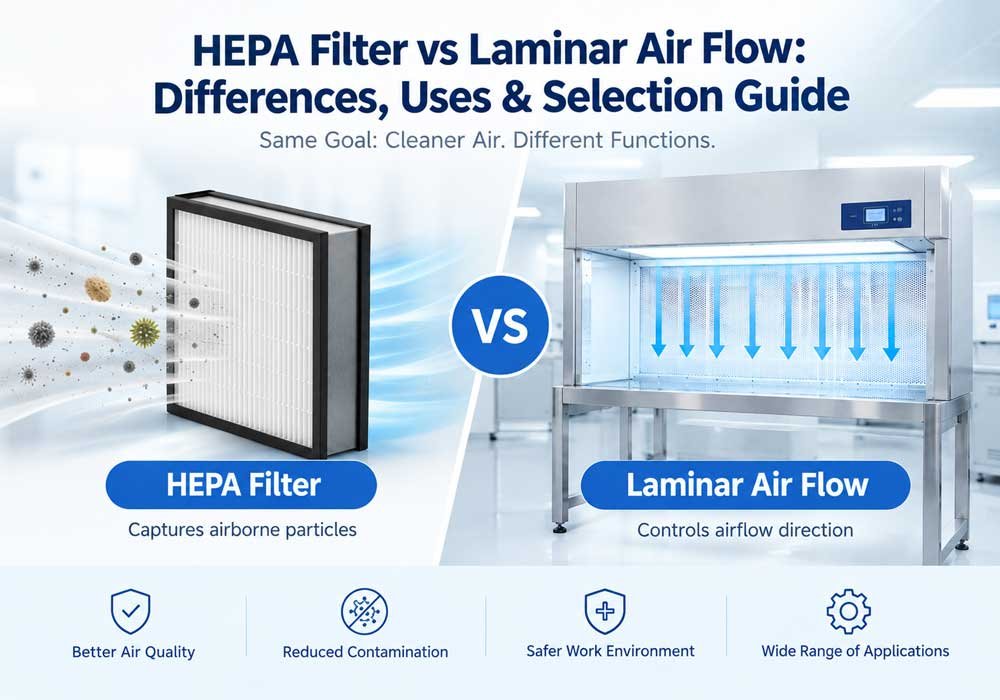
If you’re comparing a HEPA filter and a laminar air flow (LAF) unit as if they were two competing products, you’re already asking the wrong question. One is a high-efficiency filter media; the other is an engineered airflow system that often uses that filter as its final stage. Choosing the wrong one doesn’t just waste budget—it can compromise product quality, regulatory compliance, and even safety.
This guide cuts through the marketing noise and explains, in practical terms, what each technology actually does, where it belongs in your facility, and how to avoid the most costly misconceptions (like using a laminar flow hood where a biosafety cabinet is required). Whether you’re specifying equipment for pharmaceuticals, electronics, labs, or cleanrooms, you’ll leave with a clear decision framework you can apply today.
What is HEPA Filter?
HEPA filter (High-Efficiency Particulate Air) is defined by performance, not brand or material. In most regulated environments, “True HEPA” means the filter captures at least 99.97% of particles at 0.3 microns, the Most Penetrating Particle Size (MPPS). This 0.3‑micron point is the hardest size to capture; smaller and larger particles are actually removed at equal or higher efficiency.
HEPA filters work through a dense mat of randomly arranged fibers that trap particles via diffusion, interception, and inertial impaction. They excel at removing dust, pollen, mold spores, bacteria, and many aerosols—but they do not remove gases, odors, or volatile organic compounds (VOCs). For chemical or odor control, you typically need activated carbon or other gas-phase media in addition to HEPA.
In practice, you’ll see HEPA referenced alongside filter classes such as H13 or H14 (EN 1822 / ISO 29463). H13 corresponds to the familiar ≥99.97% at 0.3 μm benchmark and is widely used in hospitals, labs, and pharmaceutical settings.
What is Laminar Air Flow (LAF)?
Laminar air flow describes a unidirectional, low-turbulence airflow pattern designed to keep a work zone consistently clean. Instead of mixing air randomly, an LAF system pushes filtered air in parallel streams across a critical area, sweeping contaminants away from the product or process. This is why you often hear “ISO 5” or “Grade A” in the same sentence as laminar flow: the airflow pattern is what sustains that cleanliness class at the work surface.
A typical laminar flow cabinet (also called a laminar flow hood or clean bench) includes a blower, pre-filters, a terminal HEPA or ULPA filter, a flow straightener/diffuser, and controls for velocity and pressure. The filtered air exits the HEPA face at a controlled velocity—commonly between 0.36 and 0.54 m/s (about 70–100 fpm)—to maintain ISO Class 5 conditions while minimizing turbulence.
Crucially, laminar flow protects the product from the environment and the operator, but it does not protect the operator from hazardous materials inside the work zone. That distinction is central to safe and compliant selection.
HEPA Filter vs Laminar Air Flow: Detailed Comparison
| Feature | HEPA Filter | Laminar Air Flow |
|---|---|---|
| What it is | A high-efficiency air filter | A controlled, unidirectional airflow system |
| Main purpose | Removes airborne particles | Delivers clean air across a work area |
| Core function | Filters air | Controls airflow direction and uniformity |
| Removes particles | Yes | Not by itself; usually uses HEPA or ULPA filters |
| Controls airflow | No | Yes |
| Primary benefit | High-efficiency particle removal | Product and process contamination control |
| Typical applications | HVAC, air purifiers, cleanrooms, and filtration systems | Clean benches, laboratories, cleanrooms, pharma, and electronics |
| Can work alone? | Yes, within a suitable air-cleaning system | No, it needs fans, filters, and airflow controls |
| Safety limitation | Does not remove gases, odors, or VOCs without additional media | Does not provide personnel protection from hazardous materials |
| Relationship | Often used as the final filter in LAF systems | Commonly relies on HEPA or ULPA filtration |
How Do They Work Together?
It’s easy to see why “HEPA” and “laminar flow” get mixed up: most laminar flow cabinets rely on a HEPA (or ULPA) filter as their final filtration stage. The HEPA cleans the air; the laminar flow design ensures that clean air moves in a controlled, unidirectional way over your work area. In other words, HEPA is the heart of the filtration, while laminar flow is the circulatory system that delivers that cleanliness where you need it.
This synergy is powerful—but it also leads to a common mistake: assuming that any enclosure with a HEPA filter automatically provides personnel protection. It doesn’t. A laminar flow hood with HEPA still blows air toward or past the operator and is unsuitable for infectious agents, toxins, cytotoxic drugs, or hazardous chemicals. For those applications, you need a biosafety cabinet (BSC) or an exhausted enclosure designed and certified for containment.
Working Principles: Filtration Mechanism vs Airflow Organization
HEPA Filtration Mechanism
HEPA media captures particles through three dominant mechanisms: diffusion (for very small particles), interception (particles touching fibers), and inertial impaction (larger particles unable to follow air streamlines). The 0.3‑micron MPPS is where these mechanisms are collectively least efficient, which is why the HEPA standard is defined at this point. If a filter achieves ≥99.97% at 0.3 μm, it will perform at least as well for other sizes.
In real systems, HEPA filters are almost always paired with pre-filters to extend service life and control pressure drop. Monitoring differential pressure and scheduling integrity testing (e.g., PAO/DOP scan tests) are standard practices to ensure ongoing performance.
Laminar Air Flow System Workflow
A typical LAF workflow looks like this: room air → coarse pre-filter → fan/blower → terminal HEPA/ULPA → flow straightener → unidirectional discharge over the work zone. The result is a stable, low-turbulence environment that continuously pushes contaminants away from the critical area.
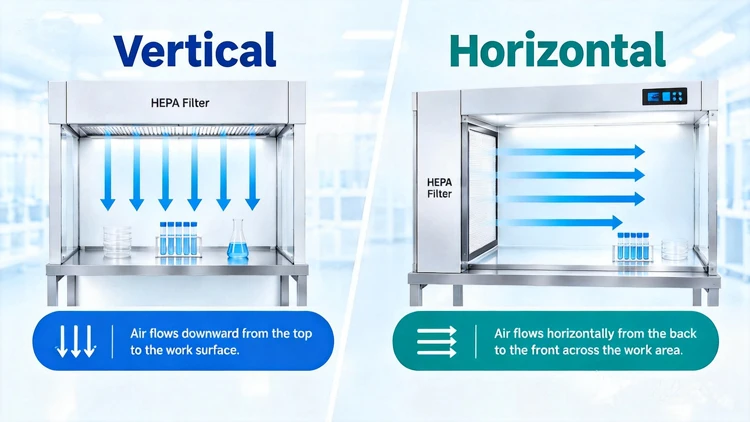
LAF cabinets come in horizontal and vertical configurations. Horizontal flow blows air across the work surface toward the operator; vertical flow sends air downward. Both can achieve ISO 5 conditions, but the direction affects ergonomics, contamination risk from the operator, and suitability for specific processes.
Key Performance Indicators Side by Side
HEPA key indicators: efficiency class (H13/H14), leakage/scan test results, pressure drop, face velocity at the filter media.
LAF key indicators: face velocity at the work opening (commonly 0.36–0.54 m/s), cleanliness class (ISO 5/Grade A), airflow uniformity, recovery time after disturbance, and positive pressure relative to the room.
Protection Objectives: Product vs People vs Environment
Understanding what you must protect is the fastest way to choose correctly.
Laminar Air Flow (LAF): Primarily protects the product or process from contamination. It creates an ISO 5/Grade A work zone for aseptic compounding, media preparation, sterile handling of non-hazardous pharmaceuticals, electronics assembly, and similar tasks. It does not protect you from what’s inside the cabinet.
HEPA Filter (as a component): Improves air cleanliness wherever it’s installed—whether in a LAF cabinet, a biosafety cabinet, a cleanroom terminal unit, or an industrial air handler. Its role depends on the system design.
Biosafety Cabinet (BSC): Designed to protect personnel, product, and environment. BSCs use HEPA-filtered laminar airflow internally but also manage exhaust and containment to shield the operator from hazardous aerosols. This is the key difference from LAF.
If your work involves infectious materials, volatile chemicals, or cytotoxic compounds, a laminar flow hood is not an acceptable solution—regardless of how “good” its HEPA filter is.
Selection Guide: When to Choose HEPA vs LAF?
Use this practical decision logic:
You need cleaner supply air at a terminal point (e.g., ceiling diffuser, equipment inlet). Focus on HEPA/ULPA filter selection, housing, sealing, and integrity testing. You may not need a full LAF cabinet.
You need a local ISO 5 workzone with continuous unidirectional flow to protect non-hazardous products. A laminar air flow cabinet is appropriate. Confirm velocity (0.36–0.54 m/s), cleanliness class, and validation requirements.
You handle infectious agents, toxins, cytotoxic drugs, or hazardous chemicals. Do not use a laminar flow hood. Select a biosafety cabinet or an exhausted enclosure designed for containment, with appropriate filtration and exhaust treatment.
Conclusion
HEPA filters and laminar air flow systems are not competitors; they serve different roles in a contamination-control strategy. HEPA is the high-efficiency filtration core; laminar air flow is the engineered system that delivers ISO 5/Grade A cleanliness to your work zone using that filtration. The right choice depends on what you must protect, what hazards are present, and which standards you must meet.
If you’re designing or upgrading a critical area, start by defining your protection goals (product, personnel, environment), confirm your required cleanliness class and regulatory framework, and then select the system and filtration that match. When in doubt, you can contact a professional CENCARB air filter manufacturer for evaluation before you buy.