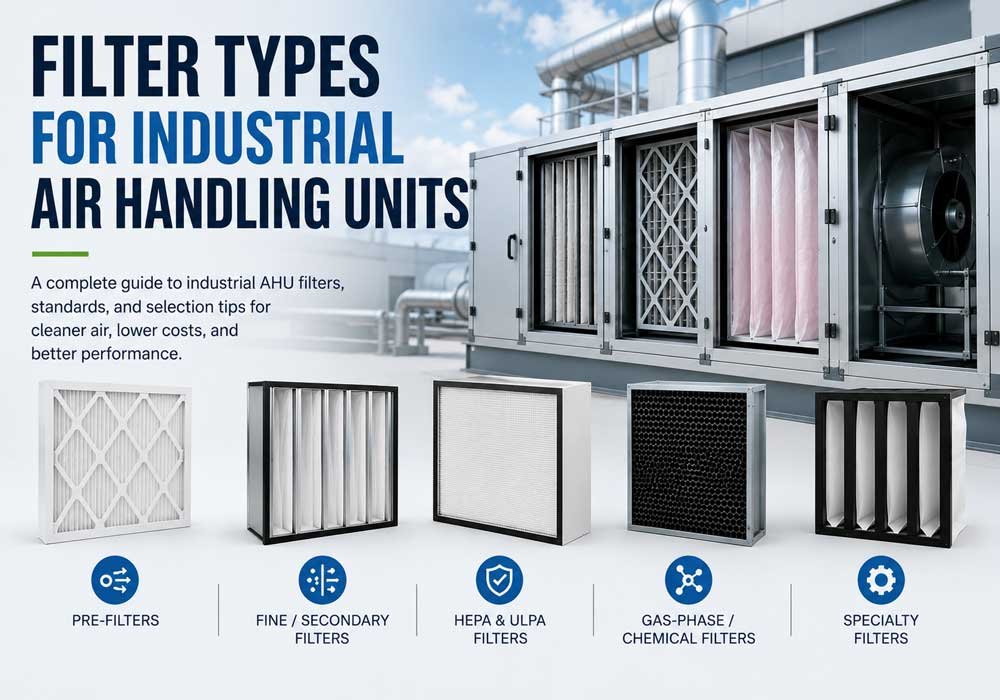
If you manage industrial air handling units (AHUs), you know filters directly affect energy use, equipment life, and indoor air quality. However, many teams still choose them out of habit or based on initial price, not total cost of ownership. This guide cuts through the noise to explain the core filter types used in industrial AHUs (G4 pre-filters, F7–F9 fine filters, H13–H14 HEPA, and activated carbon gas-phase media), where each belongs in a typical filter cascade, how standards like ISO 16890 and EN 1822 apply, and how to match your selection to real operational needs—so you can specify, procure, and maintain a system that balances performance, energy, and cost without over- or under-filtering.
Why Filter Selection Matters in Industrial AHUs
Filter selection has a direct impact on how an industrial AHU operates over its entire service life. The wrong filter can increase pressure drop, reduce airflow, shorten filter life, expose HVAC components to contamination, or fail to control the pollutants that actually matter in your facility.
A well-designed filtration system should therefore be evaluated as part of the entire AHU rather than as an isolated component. Four factors are particularly important: energy efficiency, equipment protection, air quality and compliance, and total cost of ownership.
Energy Efficiency
Filters are the single largest source of pressure drop in most AHUs. A filter with 20% higher initial resistance can increase fan energy consumption by 10–15% over its lifetime. Multiply that by 24/7 operation, and you’re looking at thousands of dollars in wasted electricity annually.
Equipment Protection
Dust accumulation on cooling coils reduces heat transfer efficiency by up to 30%. Without proper pre-filtration, you’ll face more frequent coil cleaning, unplanned downtime, and premature motor or bearing failure.
Air Quality & Compliance
In hospitals, labs, or cleanrooms, filter performance directly affects patient outcomes, product sterility, and audit results. ISO 14644-1, ASHRAE 170, and EU GMP Annex 1 all specify minimum filtration levels for different zones.
Total Cost of Ownership
The cheapest filter upfront often costs 2–3× more over three years due to higher energy use, more frequent changes, and collateral equipment damage. Smart selection balances initial price, pressure drop, dust holding capacity, and service life.
Core Filter Types for Industrial AHUs
Industrial AHUs rarely rely on a single filter. Instead, they use a staged approach—each layer targeting specific contaminants while protecting downstream components. Understanding these layers is key to building a resilient, cost-effective system; a detailed comparison of pre-filters vs fine filters vs HEPA filters.
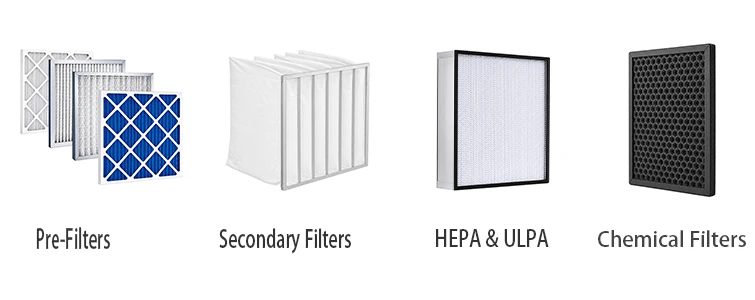
Pre-Filters (G1–G4 / MERV 4–8)
Pre-filters are your first line of defense. Installed at the AHU inlet, they capture large particles (≥5 µm) such as dust, lint, insects, and fibers. Their primary job isn’t to clean the air for occupants—it’s to protect your investment in finer, more expensive downstream filters.
Common formats include disposable panel filters (synthetic or fiberglass), washable metal mesh, and pleated cartridge designs. G4 (ISO Coarse 60–70%) is the most widely used grade in industrial settings, offering a sweet spot between protection and airflow resistance.
Tip: In high-dust environments (e.g., woodworking, mining), consider dual-stage pre-filtration: a washable G3 metal pre-filter followed by a G4 disposable panel. This can extend change-out intervals by 50% or more.
Fine / Secondary Filters (F5–F9 / MERV 11–16)
Fine filters target particles in the 1–5 µm range—pollen, mold spores, fine dust, and bacterial carriers. They’re the workhorses of IAQ improvement in offices, data centers, and general manufacturing areas.
Under ISO 16890, F7 corresponds to ePM2.5 ≥65%, F8 to ePM2.5 ≥80%, and F9 to ePM1 ≥85%. Structurally, bag (pocket) filters dominate due to their high dust holding capacity and low pressure drop. V-bank and mini-pleat designs offer compact alternatives for space-constrained AHUs.
HEPA & ULPA Filters (H13–H14 / U15–U17)
HEPA (High-Efficiency Particulate Air) filters remove ≥99.97% of particles at 0.3 µm (H13) or ≥99.995% (H14). ULPA (Ultra-Low Penetration Air) filters go further, capturing ≥99.999% at 0.12 µm (U15+).
These are terminal filters, always installed as the final stage before air enters critical zones. They’re essential in operating rooms, ISO 5–7 cleanrooms, semiconductor fabs, and biological safety labs.
Critical Note: Never install HEPA without adequate pre-filtration. A missing F7–F9 stage can clog a HEPA in weeks, not years. Always verify housing seal integrity and perform DOP/PAO leak testing after installation.
Gas-Phase / Chemical Filters (Activated Carbon & Beyond)
While particulate filters handle dust, gas-phase filters tackle invisible threats: VOCs, odors, acidic/alkaline gases (SO₂, NOₓ, ozone), and solvent vapors. For facilities near chemical plants, printing lines, or traffic corridors, these are non-negotiable.
Activated carbon remains the gold standard, available in honeycomb, granular, impregnated, or catalytic forms. Pocket-style carbon filters integrate seamlessly into AHUs, offering dual-stage particulate + gas removal in one housing.
Specialty Filters for Extreme Conditions
Not all environments fit standard categories. High-temperature processes (e.g., curing ovens) demand filters rated to 250°C+. Humid or oily atmospheres (food processing, metalworking) require hydrophobic or oleophobic media. Electrostatic precipitators offer ultra-low resistance for high-volume, low-contaminant streams.
Filter Classification Standards Explained
Confusion between EN 779, ISO 16890, MERV, and EN 1822 is common. Here’s your decoder ring.
| Standard | Scope | Key Grades | Notes |
|---|---|---|---|
| EN 779 (legacy) | General ventilation | G1–G4, F5–F9 | Replaced by ISO 16890 in EU, still referenced globally |
| ISO 16890 | Particulate efficiency by size | ePM10, ePM2.5, ePM1 | Rates filters on real-world PM fractions; F7 ≈ ePM2.5 65% |
| ASHRAE 52.2 / MERV | North American HVAC | MERV 1–16 | MERV 13 ≈ F7–F8; MERV 16 ≈ H13 entry-level hencolin |
| EN 1822 / ISO 29463 | HEPA/ULPA | H13, H14, U15–U17 | Based on MPPS (Most Penetrating Particle Size); mandatory for cleanrooms |
Note: ISO 16890 better reflects real-world performance because it tests against actual PM1, PM2.5, and PM10 distributions—not just a single test dust like EN 779 did.
Typical Multi-Stage Filter Arrangements
One configuration does not fit all. The right filter cascade depends on your facility type, compliance requirements, and energy targets—not what the last project used.
| Application | Recommended Cascade | Key Benefit |
|---|---|---|
| General Factory | G4 + F7 | Balances protection and energy; F7 captures fine dust without excessive pressure drop |
| Office / Data Center | G4 + F9 | Controls PM2.5 effectively; extends coil life; meets ASHRAE 62.1 IAQ benchmarks |
| Hospital Wards | G4 + F9 + H13 | Complies with ASHRAE 170; H13 terminal ensures pathogen control in patient areas |
| ISO 7 Cleanroom | G4 + F9 + H14 (terminal) | Satisfies ISO 14644-1; terminal H14 placement extends service life to 2–4 years |
| Chemical Lab | G4 + F9 + Activated Carbon | Removes both particulates and VOCs; prevents corrosion and odor complaints |
Customization Tip: For mixed-use facilities (e.g., office + lab + production), consider zoned filtration—different AHUs or bypass dampers tailored to each area’s risk profile. Don’t over-filter low-risk zones; don’t under-filter critical ones.
How to Select the Right Filter for Your AHUs
Selecting an industrial AHU filter should start with your operating conditions rather than with a filter catalogue.
Before choosing a product, define the contaminants you need to control, the required air quality, match AHU design, life-cycle costs and supplier qualifications, etc.
Step 1: Define Your Air Quality Goals
What standards must you meet? ISO 14644 Class? ASHRAE 170? Local EPA limits on VOCs? Start with the end in mind.
Step 2: Assess Your Contaminant Load
Measure or estimate: dust concentration (mg/m³), particle size distribution, presence of gases/VOCs, humidity, temperature. On-site air sampling is worth the investment.
Step 3: Match AHU Design Parameters
Check your fan’s available static pressure. A filter cascade exceeding this will starve the system of airflow. Verify physical dimensions (height, depth, frame type) and access for maintenance.
Step 4: Calculate Lifecycle Cost
Use this formula:
TCO = Filter Cost + (Energy Cost × Hours) + Labor + Downtime Risk
A filter with 20% lower ΔP can save more in energy than its entire purchase price over 3 years .
Step 5: Vet Your Supplier
Ask for ISO 9001 certification, third-party test reports (Eurovent, AHRI, SGS), reference installations in your industry, and warranty terms. Avoid vendors who can’t provide traceable data.
Conclusion
Selecting the right filter types for your industrial air handling unit isn’t just about clean air—it’s about protecting capital, optimizing energy, and ensuring compliance. The configurations in this guide are starting points, not final answers. Your facility’s dust load, contaminant profile, fan curve, and maintenance budget will determine the optimal cascade.